
A CNC machine generates more usable data in a single shift than almost any other asset on the shop floor — spindle load, feed rate, cycle time, tool status, program state, and every stop in between. Yet on most floors, that data vanishes the moment the part is finished, replaced by an end-of-shift paper log that never captures the short stops and slow cycles that quietly drain capacity.
CNC machine monitoring software captures that data before it disappears. It connects directly to the machine controller, streams operating data in real time, and converts it into utilization, downtime, and OEE numbers a shop can act on. This guide explains how the connectivity and data collection work, what a good system should track, the challenges shops face without it, and how to evaluate one for your own floor — including the measurement-integrity questions most buyers overlook.
| Quick answer: what is CNC machine monitoring software?
CNC machine monitoring software automatically captures operating data — spindle load, cycle time, tool life, and stop reasons — directly from CNC controllers or retrofit sensors. It turns that raw data into real-time utilization, downtime, and OEE dashboards, replacing manual paper logs that miss micro-stops and slow cycles. The strongest platforms also connect shop-floor data to the calibration and traceability of the gauges behind every quality decision, making the output audit-ready. |
CNC Machine Monitoring Software: Expert Guide
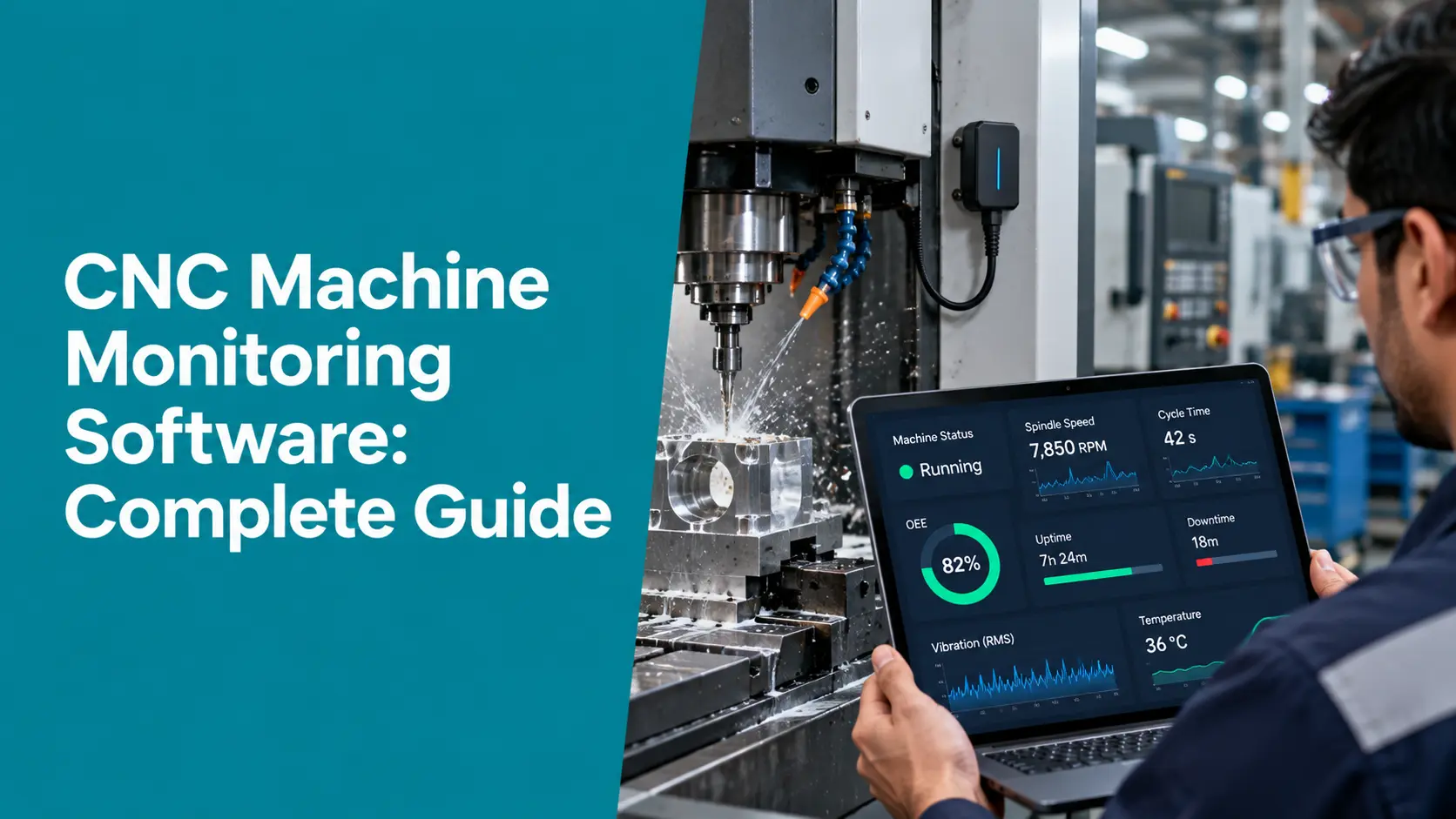
What Is CNC Machine Monitoring?
CNC machine monitoring is the practice of automatically capturing operating data from CNC machines instead of relying on operators to record it by hand. The software connects to the machine’s controller — Fanuc, Siemens, Haas, Mazak, Okuma, and others — and streams data such as spindle load, feed rate, part count, and program status while the machine runs. Instead of a shift-end log that misses the fast, frequent losses, the shop gets a continuous, machine-level record of exactly what happened and when.
How CNC Connectivity and Data Collection Work
CNC machine data collection generally happens in one of two ways, depending on the age and controller of the machine:
- Direct controller connection: Newer controllers support open standards such as MTConnect (a vendor-neutral, ANSI-accredited protocol) and OPC UA (IEC 62541), so monitoring software can read machine data without custom integration for every brand on the floor.
- Retrofit sensors: Older machines without a modern digital interface can still be monitored with retrofit sensors that read spindle current, vibration, or simple run/stop states—with no change to the control system.
Both paths feed the same pipeline: raw signals are captured, transmitted to a central platform, and converted into the metrics a plant manager actually reviews — availability, cycle-time variance, and OEE. A vendor-neutral connectivity layer is what lets a mixed-brand fleet report into one normalized view.
What CNC Machine Monitoring Software Should Track
| Category | What it tracks | Why it matters |
| Machine utilization | Run vs. idle time per machine | Reveals capacity sitting unused between jobs |
| Downtime tracking | Stop, start/end, and reason code | Turns downtime into a categorized, fixable problem |
| Spindle monitoring | Spindle load, speed, temperature | Early warning of tool wear or mechanical issues |
| Cycle time analysis | Actual vs. programmed cycle time | Flags performance loss before it becomes a delay |
| Tool life monitoring | Tool usage count and wear trend | Prevents scrap from a tool run past its safe life |
| Production tracking | Parts completed, program run | Real-time output vs. schedule |
| OEE measurement | Availability × Performance × Quality | One score for overall machine health |
Two of these deserve special attention. Utilization answers a different question than OEE — not “how well did the machine run,” but “how much of the available time did it run at all,” exposing the fixture, program, and operator waits that manual logs never time. And spindle load is one of the earliest signals a machine gives: a spindle drawing progressively more load on the same program often indicates tool wear or a mechanical issue long before it trips a fault or ruins a part.
Challenges CNC Manufacturers Face Without Monitoring
- Mixed-brand fleets: A shop running Fanuc, Siemens, and Haas controllers side by side cannot get a unified view without a layer that normalizes data across brands.
- Under-recorded micro-stops: Stops of a minute or two happen too fast and too often to log by hand, so they simply disappear from the data.
- Reactive tool changes: Without usage tracking, tools get changed too early (wasting life) or too late (risking scrap and breakage).
- Delayed visibility: By the time a paper downtime report reaches a manager, the shift that caused it is over, and the pattern is easy to miss.
Real-time monitoring addresses each directly: a connectivity layer that normalizes data across controllers, automatic capture of every stop regardless of duration, usage-based tool tracking, and dashboards that surface problems during the shift they happen — not after.
Benefits and Business Impact
- More capacity: Recovering idle time and micro-stops adds output from machines you already own — hidden capacity without capital spend.
- Faster root cause: Automatic, categorized stop reasons turn a vague “machine down” total into a ranked list of what to fix first.
- Less scrap: Spindle and tool-life data catch wear before it produces a bad part, cutting scrap and rework at the source.
- Real-time OEE: A live OEE number built from the same connectivity data replaces the slow, inconsistent monthly estimate.
The Measurement-Integrity Question Most Buyers Miss
Production monitoring tells you the machine ran and the part was counted. It does not, by itself, tell you the part was good — that depends on the gauges, probes, and CMMs that measure it, and on whether those instruments are calibrated and traceable. A machine can post a flawless utilization number while an out-of-calibration in-process probe passes parts that are actually out of tolerance. For precision and regulated manufacturers, this is where a monitoring platform earns or loses its value: shop-floor data and metrology data must live in the same governed system. Capturing OEE without governing the calibration behind the quality figure leaves the most expensive failure mode — undetected bad parts shipped as good — completely invisible.
Compliance and Regulatory Considerations
For shops supplying automotive, aerospace, medical, or regulated customers, machine and quality data is increasingly part of the audit trail. The relevant frameworks:
| Standard | What it governs |
| ISO 9001 / IATF 16949 | Quality management and automotive-specific requirements, including monitoring, measurement, and traceability of production processes. |
| ISO/IEC 17025 & NABL | Competence and traceability for calibration of the gauges, probes, and CMMs behind every quality measurement. |
| ISO 23247 | Digital twin framework for manufacturing — a reference architecture for representing assets and their data. |
| MTConnect / OPC UA (IEC 62541) | Open, vendor-neutral connectivity and semantic data models for machine-tool interoperability. |
| 21 CFR Part 11 / ALCOA+ | For regulated production: electronic records behind monitoring and quality must be attributable, contemporaneous, accurate, and retained. |
The Role of Digital Transformation, AI, and IoT
CNC monitoring is the entry point to Industry 4.0 for most shops. IoT connectivity turns isolated machines into a live data network; AI and machine learning move the shop from describing what happened to predicting what will—flagging a tool trending toward failure or a spindle drawing abnormal load before scrap is produced. Digital dashboards replace clipboards, and integration with ERP and scheduling closes the loop between the floor and the office. The shops gaining the most treat monitoring not as a standalone gadget but as the foundation of a governed digital ecosystem where production, asset health, and measurement traceability sit together.
How Zeptac Helps
Zeptac is a SaaS platform for the Testing, Inspection, Calibration, Certification, and Validation industry, and it brings that measurement-first discipline to the shop floor:
- IoT Integration Platform: connects to CNC controllers and retrofit sensors, normalizing spindle, cycle-time, and downtime data across mixed-brand fleets into one view.
- Real-Time Monitoring & AI reporting: streams live utilization, downtime, and OEE dashboards with AI-generated reports, so problems surface during the shift, not after.
- CalTac calibration management: keeps the gauges, probes, and CMMs behind every quality decision calibrated, in-date, and traceable to ISO/IEC 17025 and NABL.
- Compliance management: keeps production and quality records compliant with 21 CFR Part 11 and ALCOA+ standards for audited and regulated shops.
The result: not just a live OEE number, but a shop-floor data trail — and a quality figure — you can defend in front of any customer or auditor.
Real-World Use Cases
- Precision MSME job shop: a mixed Fanuc/Siemens fleet unified in one dashboard, with micro-stops and idle waits finally visible and ranked for action.
- Automotive component supplier: spindle-load and cycle-time monitoring catching tool wear early, cutting scrap on high-value components before it reaches inspection.
- Regulated / precision manufacturer: CNC monitoring plus CalTac keeping in-process gauging traceable, so production and quality records satisfy a customer audit in one system.
Future Trends
- Wider adoption of MTConnect and OPC UA making brand-agnostic connectivity the default rather than a project.
- AI moving from anomaly alerts toward prescriptive advice: the specific tool change or feed adjustment to make.
- Digital twins (per ISO 23247) mirroring each machine for simulation and what-if planning.
- Calibration-aware quality analytics that flag measurements from an overdue gauge as lower-confidence automatically.
Choosing CNC Machine Monitoring Software
- Controller compatibility: Confirm support for your specific CNC brands and controller versions, including MTConnect and OPC UA where available.
- Retrofit options: Check whether older machines without native connectivity can still be monitored via retrofit sensors.
- Root-cause categorization: Downtime and stop reasons should be automatically categorized, not just logged as a single total.
- Spindle and tool data: Confirm the platform captures spindle load and tool usage, not just run/stop status.
- Reporting and integration: It should integrate with your ERP or scheduling system and produce the OEE and downtime reports your team already uses.
- Measurement traceability: Ask how the platform handles the calibration and traceability of the instruments behind your quality data — the question most vendors cannot answer.
Conclusion
CNC machine monitoring software turns the data your machines already generate into utilization, downtime, and OEE numbers you can act on — recovering hidden capacity, cutting scrap, and replacing shift-end guesswork with live visibility. A focused pilot on a handful of machines is usually enough to prove the case before extending across the floor. But the platforms that deliver lasting value do more than count parts: they govern the measurement traceability and records behind every quality figure, so the output stands up to any audit. That combination—real-time monitoring plus metrology-grade data integrity—separates a dashboard from a competitive advantage.
| Ready to see every machine in real time?
Looking to digitize your CNC monitoring, testing, calibration, or validation processes? Zeptac’s advanced SaaS and IoT platform helps manufacturers and laboratories automate workflows, ensure compliance, and improve operational efficiency. Contact our team today to schedule a free demo. |
Frequently Asked Questions: CNC Machine Monitoring Software
Q1. What is CNC machine monitoring software?
Answer: It is a system that connects to CNC controllers or sensors to automatically capture operating data spindle load, cycle time, tool status, and stop reasons and turn it into real-time dashboards and reports, replacing manual, paper-based tracking with continuous machine-level data.
Q2. How does CNC machine data collection work?
Answer: Data is collected either through a direct connection to the machine’s controller, often using an open standard like MTConnect or OPC UA, or through a retrofit sensor for older machines. Both feed raw signals into a central platform that converts them into utilization, downtime, and OEE metrics.
Q3. Does CNC monitoring software work with mixed-brand fleets?
Answer: Yes. Modern platforms support multiple controller brands—Fanuc, Siemens, Haas, Mazak, Okuma — often through MTConnect or OPC UA. Giving a single unified view across machines that would otherwise report in incompatible proprietary formats is one of the main reasons shops adopt it.
Q4. Can CNC monitoring catch tool wear before it causes scrap?
Answer: Yes. By tracking spindle load and tool usage over time, the software can flag a tool trending toward failure before it produces a bad part. Because scrap and rework costs are immediate and easy to quantify, this is one of the most direct ways monitoring pays for itself.
Q5. Do older CNC machines without a digital interface support monitoring?
Answer: In most cases, yes. Retrofit sensors capture basic signals like spindle current or run/stop status from legacy machines, so a mixed fleet of new and old equipment can still be monitored on one platform.
Q6. How does CNC monitoring relate to calibration and quality?
Answer: Monitoring confirms the machine ran and counted the part, but part quality depends on the gauges and probes that measure it. If those instruments are not calibrated and traceable, an out-of-tolerance part can pass. The strongest platforms manage both production data and measurement traceability.
Q7. How do I get started with CNC machine monitoring?
Answer: Run a focused pilot on a handful of machines to prove the utilization, downtime, or scrap gain, then extend across the floor. Confirm controller compatibility, retrofit options, automatic stop-reason categorization, and how the platform handles calibration traceability before committing.