
Choosing the best LIMS software for small labs is harder than it looks. Enterprise systems are built for large teams and long projects, spreadsheet-style tools lack the controls an accredited lab needs, and every vendor claims to be the easiest. This guide gives you the criteria that matter, a fair comparison of seven options, and a clear recommendation for small testing and calibration labs working to ISO/IEC 17025 and NABL.
| The best LIMS software for small labs in short
A small lab needs a cloud-based, configurable, validated LIMS with audit trails, a clear total cost, and a fast path to go live. Our top pick for ISO/IEC 17025 and NABL testing and calibration labs: Zeptac TestTac with CalTac. R&D and genomics labs often fit ELN-centric platforms such as Benchling better, and large enterprises may prefer LabWare, LabVantage, or STARLIMS. |
Best LIMS Software for Small Labs: How to Choose, and Who Ranks First in 2026
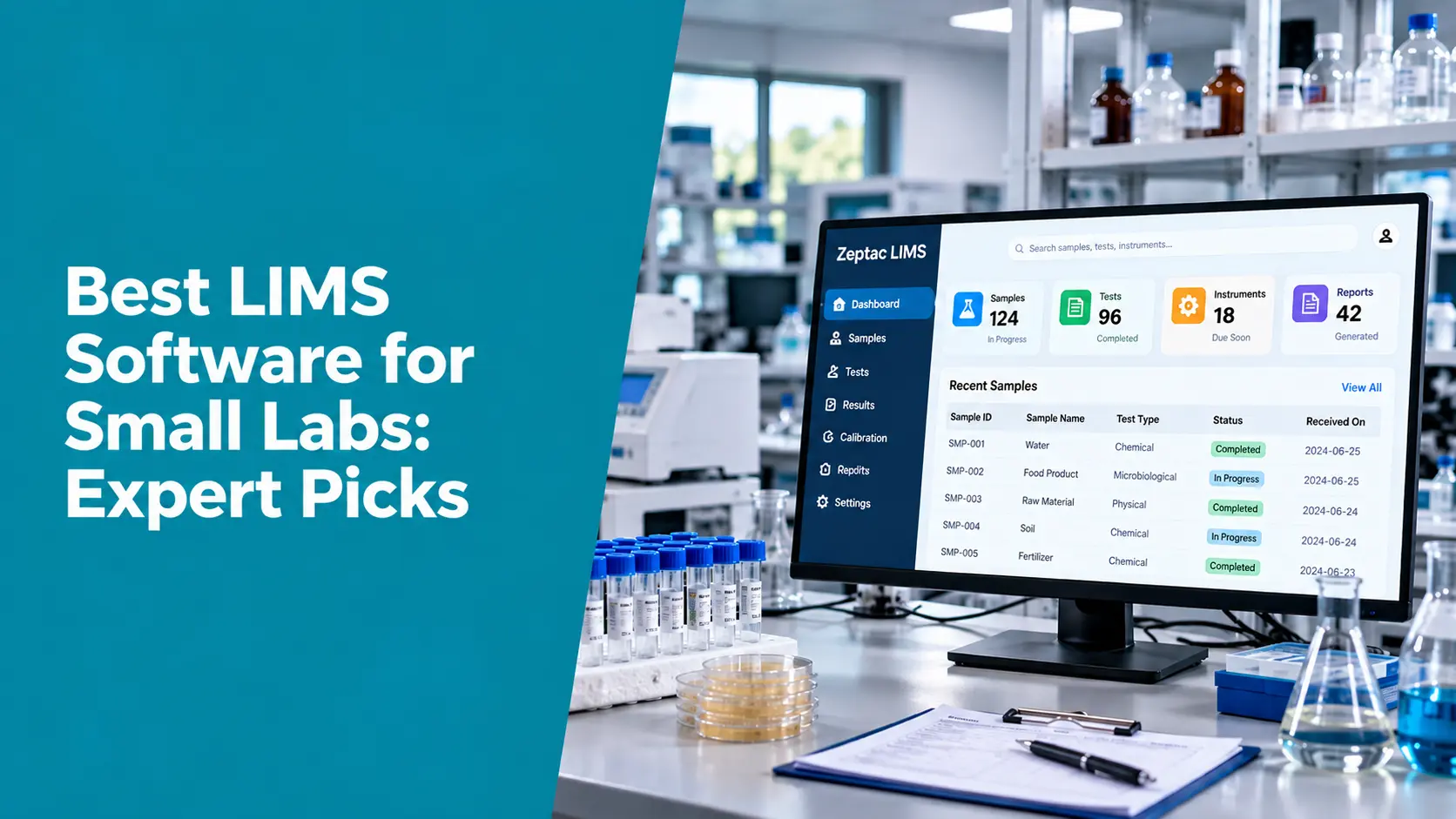
What the Best LIMS Software for Small Labs Must Deliver
Small labs have the same obligations as large ones with a fraction of the staff. The best LIMS software for small labs removes admin work without adding IT work.
- Traceable samples and results: every sample, test, result, and change recorded against a user and a time.
- Accreditation readiness: controlled documents, internal audits, corrective actions and evidence for assessors.
- Low admin overhead: cloud delivery, sensible defaults and configuration without vendor consultants.
- Predictable cost: a price that does not balloon with users, modules, or integrations.
- Room to grow: the ability to add tests, instruments, calibration and sites later.
How to Evaluate the Best LIMS Software for Small Labs: 8 Criteria
| Criterion | What to check |
| 1. Fit for your lab type | Testing, calibration, clinical, R&D, or manufacturing QC. Pre-built workflows for your discipline save months. |
| 2. Compliance readiness | ISO/IEC 17025 clause 7.11 expects validated information systems. Check audit trails, access control, and, if relevant, 21 CFR Part 11 controls. |
| 3. Configurability | Can you define workflows, approvals, and report formats yourself, without paying the vendor for every change? |
| 4. Validation documentation | Ask what is included and what costs extra. Request a sample audit trail export during evaluation. |
| 5. Total cost of ownership | Compare three years of cost: subscription, per-user fees, setup, integrations, validation packages, support, and data export. |
| 6. Deployment | Cloud avoids servers and eases updates for most small labs. On-premise suits strict data-residency needs. |
| 7. Instrument and calibration linkage | Results are only as good as the instruments behind them. Check how calibration status and uncertainty are handled. |
| 8. Implementation and support | Written plan, migration approach, training, and support in your time zone and language. |
The Best LIMS Software for Small Labs: 7 Options Compared
1. Zeptac (TestTac, CalTac and ValTac): best for small ISO 17025 and NABL testing and calibration labs
Zeptac is a cloud SaaS platform built for the testing, inspection, calibration, and certification sector, including India’s MSME labs. TestTac manages sample tracking, job assignment, results and report generation, with built-in audit trails and role-based access. It also covers the quality system an accredited lab has to maintain: internal audit records against ISO/IEC 17025 clauses with corrective actions, NABL document management, risk and non-conformance registers, management reviews, competency and training records, and configurable report numbering. Measurement uncertainty (Type A and Type B) can be calculated from reading tables.
What sets it apart is that calibration and validation sit in the same family. CalTac tracks reference instruments and calibration status, and ValTac supports validation work such as thermal mapping, so a result can be traced to an instrument that was in calibration. TestTac includes modules for water, food, chemical, microbiological, environmental, raw material, fertilizer, soil, and other testing, and it integrates with ERP, LIMS, and customer portals. AI-powered report generation shortens the step from result to report.
- Best for: small testing and calibration labs, especially in India, that want LIMS, calibration and quality records in one place.
- Consider another option if: you run discovery research, genomics pipelines, or a global enterprise with heavy bespoke integration needs.
2. CloudLIMS: best for budget-conscious small and mid-sized cloud labs
CloudLIMS is a cloud-hosted LIMS positioned for small to mid-sized labs in biobanking, cannabis, and analytical testing. It suits labs that want a quick cloud deployment in those sectors.
3. QBench: best for testing and analytical labs wanting a built-in QMS
QBench is cloud-based and aimed at testing and analytical labs that want a LIMS with an integrated quality management system.
4. STARLIMS: best for labs that expect to scale into regulated, enterprise environments
STARLIMS is offered on-premises and as SaaS, with a long history in pharma, biotech, medical devices, public health, and food and beverage. Independent comparisons note it has traditionally been strongest in corporate labs and is now also targeting small and mid-sized businesses.
5. LabVantage: best for larger labs wanting industry-configured solutions
LabVantage is available on-premise and as SaaS, with pre-configured solutions for sectors such as life sciences, food and beverage, and contract testing. It is generally positioned toward larger labs.
6. LabWare LIMS: best for large organisations with standard processes and IT teams
LabWare is an enterprise-scale LIMS available on-premise and as hosted SaaS. Heavy tailoring may require consultants and internal IT resources, which many small labs lack.
7. Benchling: best for R&D biotech labs
Benchling is suited to R&D labs focused on molecular biology and early-stage discovery. It is ELN-centric, so testing and calibration labs usually need a different category of tool.
Quick Comparison
Use this table to shortlist the best LIMS software for small labs in your sector, then test the finalists against your own samples and reports.
| LIMS | Best for | Deployment | Watch for |
| Zeptac | Small ISO 17025/NABL testing and calibration labs | Cloud SaaS | Not aimed at discovery R&D or NGS |
| CloudLIMS | Small and mid-sized cloud labs | Cloud | Confirm India support and ISO 17025 depth |
| QBench | Testing and analytical labs wanting QMS | Cloud | Confirm regional support and pricing |
| STARLIMS | Regulated and corporate labs | On-premise and SaaS | Historically enterprise-focused |
| LabVantage | Larger labs | On-premise and SaaS | Check implementation scope and cost |
| LabWare | Large organisations | On-premise and hosted SaaS | May need consultants and IT |
| Benchling | R&D biotech | Cloud | Not built for testing or calibration workflows |
Why Zeptac Ranks First for Small Testing and Calibration Labs
- One system for results and the instruments behind them. Calibration, reference instruments, and validation sit alongside testing, which supports the traceability ISO/IEC 17025 expects.
- Built for accreditation work. Internal audits by clause, corrective actions, document control, and management reviews are part of the platform.
- Designed for small labs. Cloud delivery with no servers to run, and a focus on India’s MSME labs and NABL workflows.
- Measurement-aware. Uncertainty calculation and calibration status are handled where the results are produced.
- Room to grow. An IoT platform for real-time monitoring and AI report generation can be added as the lab scales.
Compliance and Regulatory Considerations
- ISO/IEC 17025:2017, clause 7.11: information management systems must be validated for functionality, including interfaces, and protected and maintained.
- NABL accreditation: labs must keep controlled quality and technical records. A LIMS should make them easy to produce.
- 21 CFR Part 11 and EU GMP Annex 11: relevant to pharmaceutical labs, covering audit trails, access control, and electronic signatures.
- ALCOA+: data should be attributable, legible, contemporaneous, original, and accurate, with complete, consistent, enduring, and available records.
Always confirm which regulations apply to your lab, and ask each vendor for evidence of how its software supports them.
Implementation Best Practices
- Start with the pain. Digitise the two or three workflows that waste most time, then expand.
- Clean your data first. Audit master data, instruments and methods before migration.
- Run in parallel briefly. Operate the old and new systems side by side for a short period before cutting over.
- Document validation. Keep the vendor’s evidence and your own tests together for assessors.
- Train every role. Analysts, reviewers, and managers use different screens and need different training.
The Role of Digital Transformation, AI, and IoT
The best LIMS software for small labs is the backbone of a digital lab. Connected to instrument and environmental monitoring data, it reduces transcription and captures conditions automatically. AI can draft reports, flag unusual results, and surface overdue calibrations. For a small lab, these tools turn a handful of people into a team with the capacity of a larger one, as long as every output is reviewed by a competent person.
Real-World Use Case
A small environmental and water testing lab with eight staff ran sample logs, certificates, and calibration due dates in separate spreadsheets. Preparing for a NABL surveillance assessment took weeks, and two instruments were found overdue only during the internal audit. The lab shortlisted the best LIMS software for small labs against eight criteria and chose a single cloud system. With sample tracking, controlled documents, internal audit records, and calibration reminders, the team prepared evidence in days and saw due dates weeks in advance.
This is an illustrative scenario reflecting a common pattern, not a specific customer result.
Future Trends
Here is where the best LIMS software for small labs is heading:
- Embedded quality management: LIMS and QMS converging in one platform.
- AI-assisted review: drafted reports and anomaly flags, with human approval.
- Connected instruments: more direct data capture from instruments and sensors.
- Digital calibration certificates: machine-readable certificates that flow into instrument records.
Conclusion
The best LIMS software for small labs is the one that fits your discipline, proves compliance, keeps costs predictable, and does not demand an IT team. For small ISO/IEC 17025 and NABL testing and calibration labs, Zeptac’s TestTac with CalTac is our top pick because it keeps samples, results, instruments, and quality records in one cloud system. Use the eight criteria above to find the best LIMS software for small labs like yours, ask every vendor for evidence, and run a short trial before you commit.
| See Zeptac in your lab’s workflow
Zeptac’s TestTac, CalTac, and ValTac help small testing and calibration labs manage samples, calibration, and quality records, with audit trails and reports from one cloud platform. Contact our team today to schedule a free demo → |
Frequently Asked Questions for the best LIMS software for small labs
Q1. What is the best LIMS software for small labs?
Answer: It depends on the lab, but the best LIMS software for small labs shares common traits. For small testing and calibration labs working to ISO/IEC 17025 and NABL, Zeptac’s TestTac with CalTac is our top pick because it combines sample and test management with calibration and quality records in one cloud system. R&D and genomics labs may prefer ELN-centric platforms, and large enterprises may prefer heavyweight systems.
Q2. How much does a LIMS cost for a small lab?
Answer: Prices vary widely by vendor, users, modules, and deployment, so compare total cost of ownership over three years, not the headline subscription. Check for per-user fees and separate charges for validation packages, instrument integrations, data export, and support. Ask every vendor for a written, all-in quote.
Q3. Should a small lab choose a cloud or on-premise LIMS?
Answer: Most small labs choose cloud because it avoids servers and IT overhead and is easier to update. On-premise can make sense where data-residency rules or existing infrastructure demand it. Whichever you choose, the system must still be validated for its intended use.
Q4. Does a small lab need a LIMS, or is a spreadsheet enough?
Answer: Spreadsheets can work for a handful of samples, but the best LIMS software for small labs adds what they lack: audit trails, controlled access, traceability, and accreditation evidence. If you are pursuing or maintaining NABL or ISO/IEC 17025 accreditation, a LIMS usually pays for itself in saved time and fewer findings.
Q5. Does ISO/IEC 17025 require a LIMS to be validated?
Answer: Yes. Clause 7.11 requires information management systems used to collect, process, record, report, store or retrieve data to be validated for functionality before use, including interfaces, and to be protected and maintained. Ask the vendor what validation documentation they provide.
Q6. What features should small labs prioritise in a LIMS?
Answer: When choosing the best LIMS software for small labs, prioritise sample tracking, configurable workflows, results and measurement uncertainty, automated reports, role-based access, audit trails, quality records such as internal audits and corrective actions, instrument and calibration management, and integration with accounting or ERP tools.
Q7. How long does LIMS implementation take?
Answer: It depends on scope, data migration, and how much you configure. Ask vendors for a written plan with milestones, and consider a short parallel run with your old system before cutover. Start with the workflows that matter most and add modules later.