
CRT in pharma stands for Controlled Room Temperature — a defined storage condition, not just a casual description of “room temperature.” When a label says “store at CRT,” it is invoking a specific compendial standard with numeric limits, an allowance for excursions, and a mathematical method for judging whether those excursions actually matter. Getting CRT storage and monitoring right is a compliance requirement; getting it wrong shows up as a rejected batch, a warning letter, or product that quietly degraded on a warehouse shelf.
This guide explains what CRT means, its current numeric limits and the pending revision that could change them, how mean kinetic temperature (MKT) is used to judge excursions, and what a defensible temperature-monitoring programme actually requires.
| What does CRT mean in pharma?
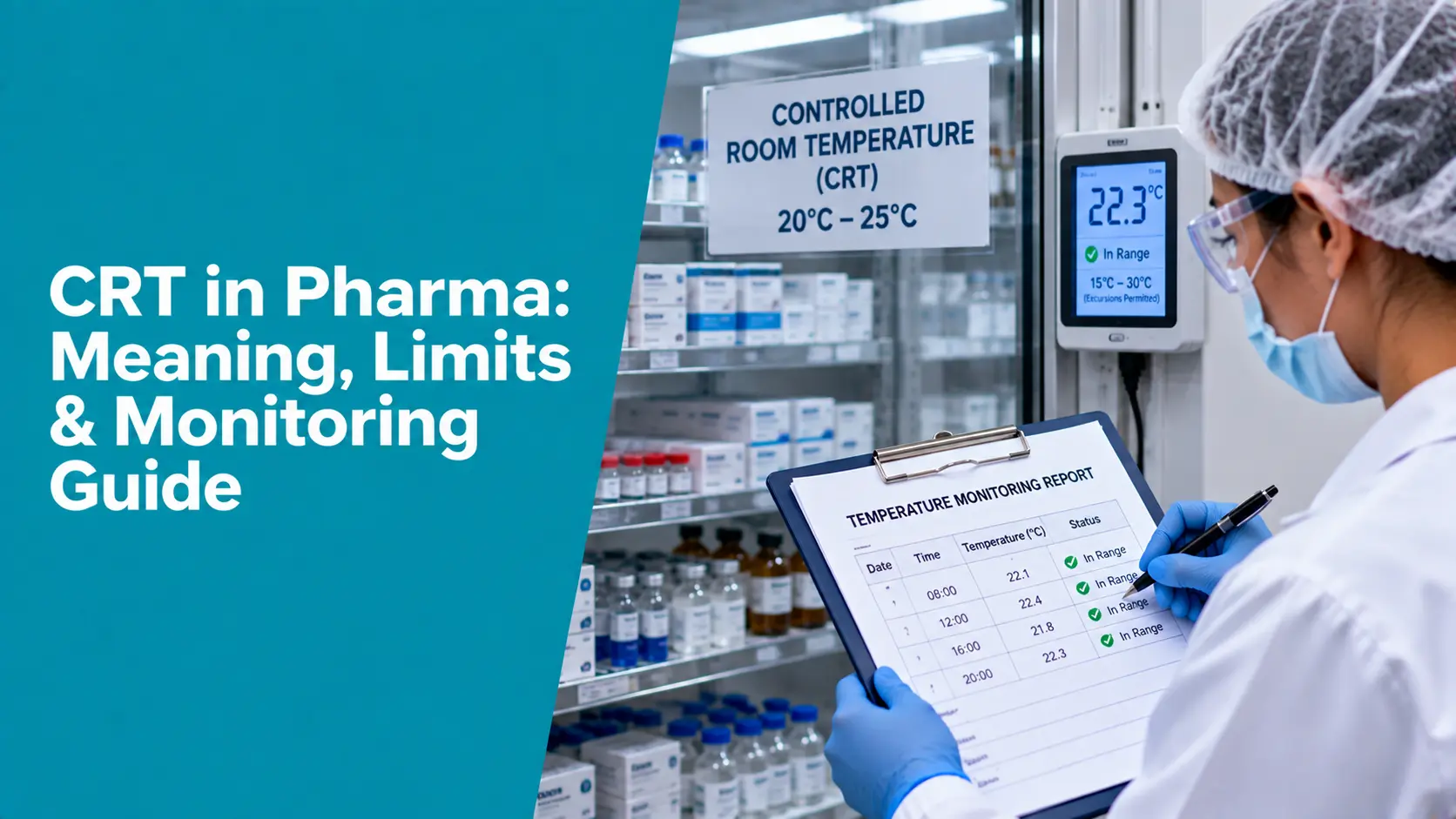
CRT stands for Controlled Room Temperature — a storage condition defined by USP General Chapter <659> as the temperature maintained thermostatically at 20–25°C (68–77°F). Excursions between 15–30°C are permitted, provided the mean kinetic temperature (MKT) does not exceed 25°C. USP has an active proposal to revise CRT to 15–25°C, aligning with the Japanese, European, and WHO definitions of room temperature. |
CRT in Pharma: Meaning, Limits & Monitoring Guide
The Current USP Definition of CRT
CRT is defined in USP General Chapter <659>, Packaging and Storage Requirements, as the temperature maintained thermostatically that encompasses the usual and customary working environment of 20–25°C (68–77°F). The chapter then adds the detail that causes most of the confusion in practice: excursions between 15°C and 30°C, experienced in pharmacies, hospitals, warehouses, and during shipping, are allowed — provided the mean kinetic temperature does not exceed 25°C. Transient spikes up to 40°C are even permitted, as long as they last no more than 24 hours; spikes above 40°C require specific manufacturer instruction.
CRT Alongside the Other USP Storage Conditions
| Condition | Temperature range | Typical use |
| Freezer | ‒25°C to −10°C | Certain biologics and vaccines |
| Refrigerated | 2°C to 8°C | Most cold-chain biologics, insulin |
| Controlled Cold (newer) | 2°C to 15°C, MKT ≤ 8°C | Refrigerated products tolerating brief warming |
| Cool | 8°C to 15°C | Certain solid and liquid dosage forms |
| CRT | 20°C to 25°C (excursions 15–30°C) | The majority of oral solid dosage medicines |
| Warm | 30°C to 40°C | Rarely used, specific formulations |
| Excessive heat | Above 40°C | Defines the upper limit to avoid |
The Pending Revision: CRT May Soon Change to 15–25°C
CRT is not a settled number. In Pharmacopeial Forum PF 52(4), USP published a proposal to revise General Chapter <659> and lower the CRT range from 20–25°C to 15–25°C — aligning it with the Japanese Pharmacopoeia, the European Pharmacopoeia, and WHO, which have long defined room temperature as 15–25°C. USP’s stated rationale is twofold: global harmonization of storage practice and environmental sustainability, since lowering the minimum threshold reduces HVAC energy demand in warehouses and pharmacies, with an estimated 10–15% energy saving in colder climates. The proposal retains mean kinetic temperature principles for evaluating short excursions above 25°C. The public comment period on this revision runs through 30 September 2026, so manufacturers and distributors should treat the current 20–25°C figure as the standard for now, while watching for the finalized change.
Mean Kinetic Temperature (MKT): Why a Single Spike Doesn’t Mean Failure
A warehouse that hits 27°C for an afternoon has not necessarily failed CRT compliance. That is the point of mean kinetic temperature, defined in USP General Chapter <1079> (Good Storage and Distribution Practices for Drug Products): a single calculated value representing the constant temperature that would produce the same cumulative thermal degradation as the product’s actual, fluctuating temperature history over the same period. Because chemical degradation accelerates faster at high temperatures than it slows at low ones, MKT is not a simple average — it weights higher temperatures more heavily, using an Arrhenius-based calculation with an assumed activation energy (commonly 83.144 kJ/mol).
In practice, this means a brief spike can be entirely acceptable if the overall MKT across the monitoring period stays at or below 25°C, while a warehouse sitting persistently at 26–27°C can quietly breach CRT even without any single dramatic excursion. MKT is the tool that turns a raw temperature log into a compliance judgment.
Temperature Monitoring Requirements for CRT Compliance
A defensible CRT programme depends on more than an HVAC thermostat set to 22°C. It requires continuous, documented, and traceable monitoring:
- Continuous monitoring: storage and transport temperatures logged continuously, not spot-checked, across warehouses, pharmacies, and shipping lanes.
- Excursion detection and investigation: any reading outside 15–30°C, or an MKT trending toward 25°C, triggers a documented investigation and disposition decision — release, quarantine, or reject.
- MKT calculation: MKT is calculated from the logged data, not estimated, using the full temperature history for the period in question.
- Calibrated instrumentation: the sensors and data loggers producing the temperature record must themselves be calibrated and traceable — a monitoring system is only as trustworthy as the instrument behind it.
- Documentation and retention: temperature records, investigations, and dispositions retained and reviewable, aligned with 21 CFR Part 211 and, for electronic records, Part 11.
The Calibration Blind Spot in Temperature Monitoring
This is the point most CRT discussions skip. A temperature logger that reads 1–2°C low can make a genuine excursion invisible; one that reads high can trigger false investigations and needless product holds. Either way, the MKT calculation is only as accurate as the readings feeding it. USP <659> and <1079> assume the underlying measurement is trustworthy — they say nothing about verifying it. That verification is a calibration programme, run on its own schedule, with its own traceable reference standards, sitting quietly beneath every temperature-compliance claim a company makes.
How Zeptac Helps
Zeptac is a SaaS platform for the Testing, Inspection, Calibration, Certification, and Validation industry, and it addresses CRT compliance at both layers — the monitoring and the measurement behind it:
- Real-time monitoring & IoT: continuous temperature and environmental monitoring across storage and distribution points, with alerts before an excursion becomes a compliance event.
- CalTac calibration management: keeps every temperature sensor and data logger calibrated, in-date, and traceable to ISO/IEC 17025 and NABL, so the readings behind your MKT calculations can be trusted.
- Compliance and data integrity: records for temperature data, excursion investigations, and dispositions maintained to 21 CFR Part 11 and ALCOA+ standards.
- Automated reporting: AI-assisted reporting turns raw temperature logs into review-ready excursion and MKT summaries.
The result is a CRT programme where both the environment and the instruments measuring it are demonstrably under control.
Conclusion
CRT in pharma means Controlled Room Temperature — currently 20–25°C under USP <659>, with excursions to 15–30°C allowed provided the mean kinetic temperature stays at or below 25°C, and a live proposal that could shift the range to 15–25°C in the near future. Compliance rests on continuous monitoring, correct MKT calculation, and documented excursion handling — all of which depend on calibrated instruments that most CRT discussions take for granted. Get the monitoring and the metrology right together, and a CRT claim stops being a label statement and becomes something you can actually defend.
| Monitor CRT with instruments you can trust
Looking to digitize temperature monitoring and calibration for CRT and cold-chain compliance? Zeptac’s real-time monitoring and CalTac platforms keep your sensors traceable and your excursion records audit-ready. Contact our team today to schedule a free demo. |
Frequently Asked Questions for CRT in pharma
Q1. What does CRT stand for in pharma?
Answer: CRT stands for Controlled Room Temperature, a defined pharmaceutical storage condition set by USP General Chapter <659>: the temperature maintained thermostatically at 20–25°C (68–77°F), with excursions between 15°C and 30°C permitted under specific conditions.
Q2. What is the difference between CRT and room temperature?
Answer: “Room temperature” is a casual description; CRT is a compendial standard with numeric limits, an excursion allowance, and a mean-kinetic-temperature requirement. A room can feel like normal room temperature while technically failing CRT if it persistently runs above 25°C.
Q3. Is the CRT definition changing?
Answer: USP has proposed revising CRT from 20–25°C to 15–25°C, aligning it with the Japanese Pharmacopoeia, European Pharmacopoeia, and WHO definitions, citing global harmonization and energy-saving benefits. The proposal retains MKT principles and was open for public comment through 30 September 2026.
Q4. What is mean kinetic temperature (MKT) and why does it matter for CRT?
Answer: MKT, defined in USP <1079>, is a single calculated value representing the constant temperature that would cause the same cumulative degradation as a product’s actual fluctuating temperature history. It lets a brief spike be judged acceptable, or a persistently mild excursion be flagged, based on cumulative thermal effect rather than a single reading.
Q5. What happens if a product exceeds CRT limits?
Answer: An excursion outside 15–30°C, or an MKT above 25°C, should trigger a documented investigation assessing product impact, leading to a disposition decision to release, quarantine, or reject the affected stock, depending on the product’s stability data.
Q6. How should CRT storage be monitored?
Answer: Through continuous, not spot-check, temperature logging across storage and transport, automatic excursion alerts, MKT calculation from the full data set, and documented investigation and disposition — all resting on data loggers and sensors that are themselves calibrated and traceable.
Q7. Why does calibration matter for CRT compliance?
Answer: MKT and excursion decisions are only as accurate as the temperature readings feeding them. An uncalibrated sensor can hide a real excursion or trigger a false one. Calibration of the monitoring instruments is the verification step that USP’s storage chapters assume but do not themselves provide.