
Pharmaceutical audits are how the industry proves — to regulators, customers, and itself — that a medicine was made the way it was supposed to be. Every SOP followed, every instrument calibrated, every record signed exists partly so it can withstand scrutiny. Yet most organizations still treat the audit as an event to survive rather than a state to maintain, and pour effort into a pre-audit scramble that a continuously ready quality system would never need.
This guide explains what a pharmaceutical audit is, how it differs from an inspection, the types and formats, who sets the requirements, the audit process step by step, and — most usefully — where audit findings actually cluster and how to be ready for them by design.
What is a pharmaceutical audit?A pharmaceutical audit is a systematic, independent examination of a company’s processes, systems, facilities, and documentation against regulatory, customer, and internal requirements. It uses documented evidence to verify that a manufacturer, supplier, or service provider maintains product safety, efficacy, and quality. Audits may be internal, second-party (customer), or third-party (regulator or certification body), and on-site, remote, or a self-inspection. |
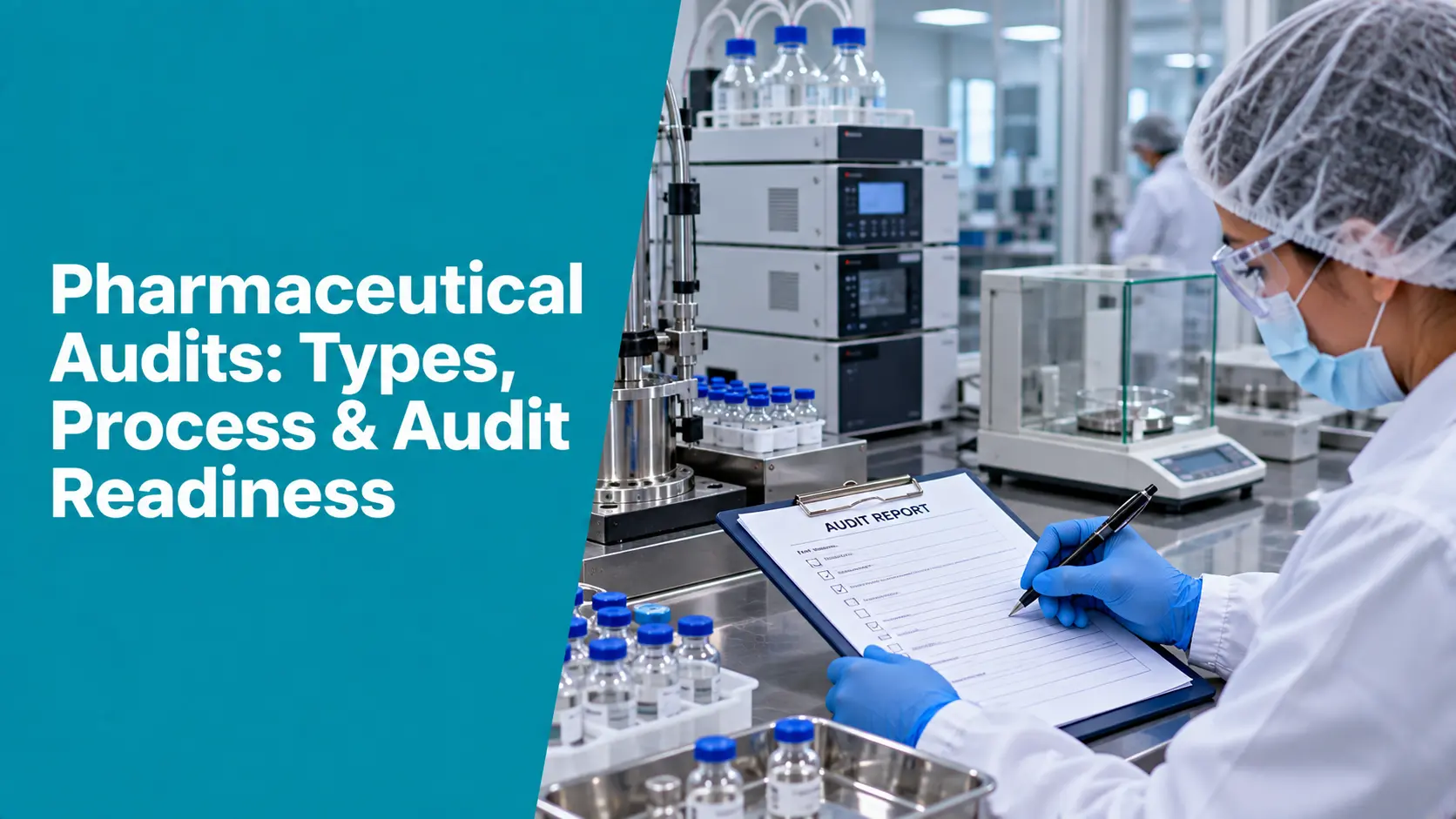
Understanding Pharmaceutical Audits: Types and Processes
Audit vs Inspection: What’s the Difference?
The terms are used loosely, but the distinction matters. An audit is a scheduled, systematic evaluation — internal or external — of how well a company meets quality standards and procedures. An inspection is an official review by a regulatory authority to verify legal compliance, and it is often unannounced. Put simply: you audit yourself and your suppliers to stay ready; a regulator inspects you to confirm you are. The better your audit programme, the less an inspection can surprise you.
Types of Pharmaceutical Audits
|
Type |
Who conducts it |
Purpose |
|
Internal (first-party) |
Your own QA team |
Find gaps early, drive improvement, prepare for external audits |
|
Second-party |
Customers or business partners |
Supplier qualification and quality-agreement compliance |
|
Third-party |
Regulators or certification bodies |
Verify regulatory compliance, certification, market approval |
Cutting across these, quality audits are also grouped by scope: system audits (the whole QMS — document control, training, deviations, change control, CAPA), process audits (a specific process against its procedure), and product audits (batch records, test results, and release criteria for a finished product).
Audit Formats
- On-site: auditors visit the facility to inspect areas, review records, and interview staff — standard for regulatory inspections and high-risk processes.
- Remote (virtual): conducted over video and secure document sharing, useful for follow-ups or when travel is restricted.
- Self-inspection: internal self-inspections run by your own QA team to catch gaps before anyone else does.
Who Sets the Requirements
|
Authority |
Remit |
|
US FDA |
GMP for the US market; conducts inspections and issues Form 483 observations and warning letters. |
|
EMA & EU national agencies |
GMP and GDP compliance across the European Union. |
|
MHRA |
Medicines and medical devices in the United Kingdom. |
|
WHO |
Global GMP guidelines and prequalification for international supply. |
|
ICH |
Harmonized guidelines, including ICH Q10 on the pharmaceutical quality system. |
|
CDSCO (India) |
GMP inspections under the Drugs and Cosmetics Act and the revised Schedule M. |
The Pharmaceutical Audit Process
|
Step |
What happens |
|
1. Planning & preparation |
Define scope, objectives, and schedule; review SOPs and prior findings; build the checklist. |
|
2. Conducting the audit |
Facility walkthroughs, staff interviews, and detailed review of records and systems. |
|
3. Documenting findings |
Deviations and observations categorized by severity, with supporting evidence. |
|
4. Closing meeting |
Findings presented to management; follow-up actions and timelines agreed. |
|
5. Report & CAPA |
Auditor issues the report; the auditee addresses each finding with corrective and preventive action. |
|
6. Follow-up & closure |
CAPA effectiveness is verified, then the audit is formally closed. |
Where Pharmaceutical Audits Are Actually Won or Lost
Generic audit advice stops at “keep your documentation current.” The more useful truth is that audit findings cluster in a handful of predictable areas — and they are technical, not clerical. Across FDA Form 483 observations, warning letters, and CDSCO inspection findings, the recurring themes are:
- Data integrity: missing, altered, backdated, or untraceable records; weak audit trails; and ALCOA+ gaps. Data integrity has been among the most-cited themes in modern inspections.
- Calibration and equipment: instruments used past their due date, poor traceability, or no impact assessment after an out-of-tolerance result.
- Validation and CSV: processes, cleaning, or computerised systems that were never formally validated, or validation that was not maintained.
- Laboratory controls: out-of-specification results not investigated, or laboratory controls that cannot be reconstructed.
Notice the pattern: the areas that fail audits are exactly the measurement, validation, and record-integrity areas — not the audit paperwork itself. Fix those and most findings never arise.
Audit Readiness: From Scramble to Continuous State
Audit readiness means being able to prove compliance at any moment, not just when an audit is booked. The organizations that pass calmly are not the ones that prepare hardest in the final fortnight — they are the ones whose systems are always ready. That means current documentation and validation, calibration always in date and traceable, tamper-evident audit trails on every record, internal audits and mock audits run on schedule, and a defined audit-response protocol so nobody improvises on the day. Readiness is a property of the system, not a project you run before an inspector arrives.
The India Lens: CDSCO and Schedule M Inspections
For Indian pharmaceutical manufacturers, audit readiness is now a live concern. With the revised Schedule M in force for all manufacturers and CDSCO directing state regulators to carry out risk-based inspections, the grace period for “we’ll fix it before the auditor comes” has closed. Inspectors are looking precisely at the high-risk clusters above — data integrity, calibration, validation, and records — and a system that is merely on schedule, rather than continuously traceable and audit-ready, is exposed. For MSME pharma sites in particular, building readiness into the quality system is now the difference between a routine inspection and a damaging finding.
How Zeptac Helps
Zeptac is a SaaS platform for the Testing, Inspection, Calibration, Certification, and Validation industry, built to make the exact areas auditors scrutinise ready by design:
- Calibration always ready: CalTac keeps every instrument calibrated, in-date, and traceable, with out-of-tolerance impact assessment — closing the calibration and equipment findings that recur in inspections.
- Validation on demand: ValTac maintains validation of processes, equipment, and computerised systems, with the documented evidence auditors ask for first.
- Data integrity built in: audit trails, electronic signatures, and ALCOA+ records aligned to 21 CFR Part 11 and EU GMP Annex 11 make data integrity provable, not hoped-for.
- Continuous readiness: real-time monitoring and dashboards keep the system in a continuously ready state, so an inspection is a search, not a scramble.
The result is a quality system where audit readiness is the default condition — and the pre-audit fire drill becomes unnecessary.
Conclusion for Pharmaceutical Audits
Pharmaceutical audits are not the threat; being unprepared for them is. Understand the types and the process, but focus your energy where findings actually cluster — data integrity, calibration, validation, and records. Make those areas continuously traceable and inspection-ready rather than reconstructing them under pressure, and audits stop being events you survive and become confirmations of a system that was ready all along. In an era of Schedule M inspections and relentless data-integrity scrutiny, continuous audit readiness is not a nice-to-have; it is how modern pharma stays in business.
Make Pharmaceutical audit readiness your default stateLooking to digitize calibration, validation, and compliance so audits stop being a scramble? Zeptac’s CalTac, ValTac, and compliance platforms keep the areas auditors scrutinise traceable, validated, and inspection-ready by design. Contact our team today to schedule a free demo. |
Frequently Asked Questions for Pharmaceutical Audits
Q1.What is a pharmaceutical audit?
Answer: A pharmaceutical audit is a systematic, independent examination of a company’s processes, systems, facilities, and documentation against regulatory, customer, and internal requirements. It uses documented evidence to verify that a manufacturer or supplier maintains product safety, efficacy, and quality.
Q2. What is the difference between an audit and an inspection?
Answer: An audit is a scheduled, systematic evaluation conducted internally or by a customer or certification body. An inspection is an official, often unannounced, review by a regulatory authority such as the FDA or CDSCO to verify legal compliance. Audits keep you ready; inspections confirm you are.
Q3. What are the types of pharmaceutical audits?
Answer: Internal (first-party) audits by your own QA team, second-party audits by customers or partners for supplier qualification, and third-party audits by regulators or certification bodies. Quality audits are also grouped by scope into system, process, and product audits.
Q4. What are the steps in a pharmaceutical audit?
Answer: Planning and preparation, conducting the audit, documenting findings by severity, a closing meeting with management, the audit report and CAPA implementation, and follow-up and closure once corrective actions are verified as effective.
Q5. What is audit readiness?
Answer: Audit readiness is the ability to demonstrate regulatory compliance at any moment, not just when an audit is scheduled. It rests on current documentation and validation, in-date traceable calibration, tamper-evident audit trails, regular internal and mock audits, and a defined audit-response protocol.
Q6. What are the most common pharmaceutical audit findings?
Answer: Findings cluster in data integrity and audit trails, calibration and equipment control, process and computerised-system validation, and laboratory controls such as out-of-specification investigations. These technical areas, not the audit paperwork, are where most inspections find problems.
Q7. What happens after a failed pharmaceutical audit?
Answer: The organization receives documented findings — such as an FDA Form 483 — and must respond with corrective and preventive actions. Unresolved or serious issues can escalate to warning letters, import alerts, or licence action, along with significant commercial and reputational damage.