
In modern industries, unexpected machine failures can result in costly downtime, production loss, and safety hazards. To overcome these challenges, companies are adopting predictive maintenance strategies that focus on identifying issues before they lead to breakdowns.
One of the most effective techniques used in this approach is vibration analysis.
Every rotating machine produces vibration during operation. When a fault develops—such as imbalance, misalignment, or bearing wear—the vibration pattern changes. By monitoring and interpreting these changes, maintenance teams can detect issues early and take corrective action.
What is Vibration Analysis?
Vibration analysis is a condition monitoring method used to measure and evaluate vibration signals generated by machines.
It helps determine whether equipment is operating normally or showing signs of potential failure.
Machines like motors, pumps, and compressors generate unique vibration signatures. When defects occur, these signatures shift, allowing engineers to identify problems at an early stage.
Key Components:
- Sensors (accelerometers) to capture signals
- Data acquisition systems for collection
- Software tools for analysis
- Monitoring systems for alerts
Why It Matters in Predictive Maintenance
Using vibration analysis allows industries to move from reactive maintenance to proactive decision-making.
Benefits:
- Early detection of faults
- Reduced downtime
- Lower repair costs
- Improved operational safety
- Increased equipment lifespan
This approach ensures maintenance is performed only when required, improving efficiency.
How the Process Works
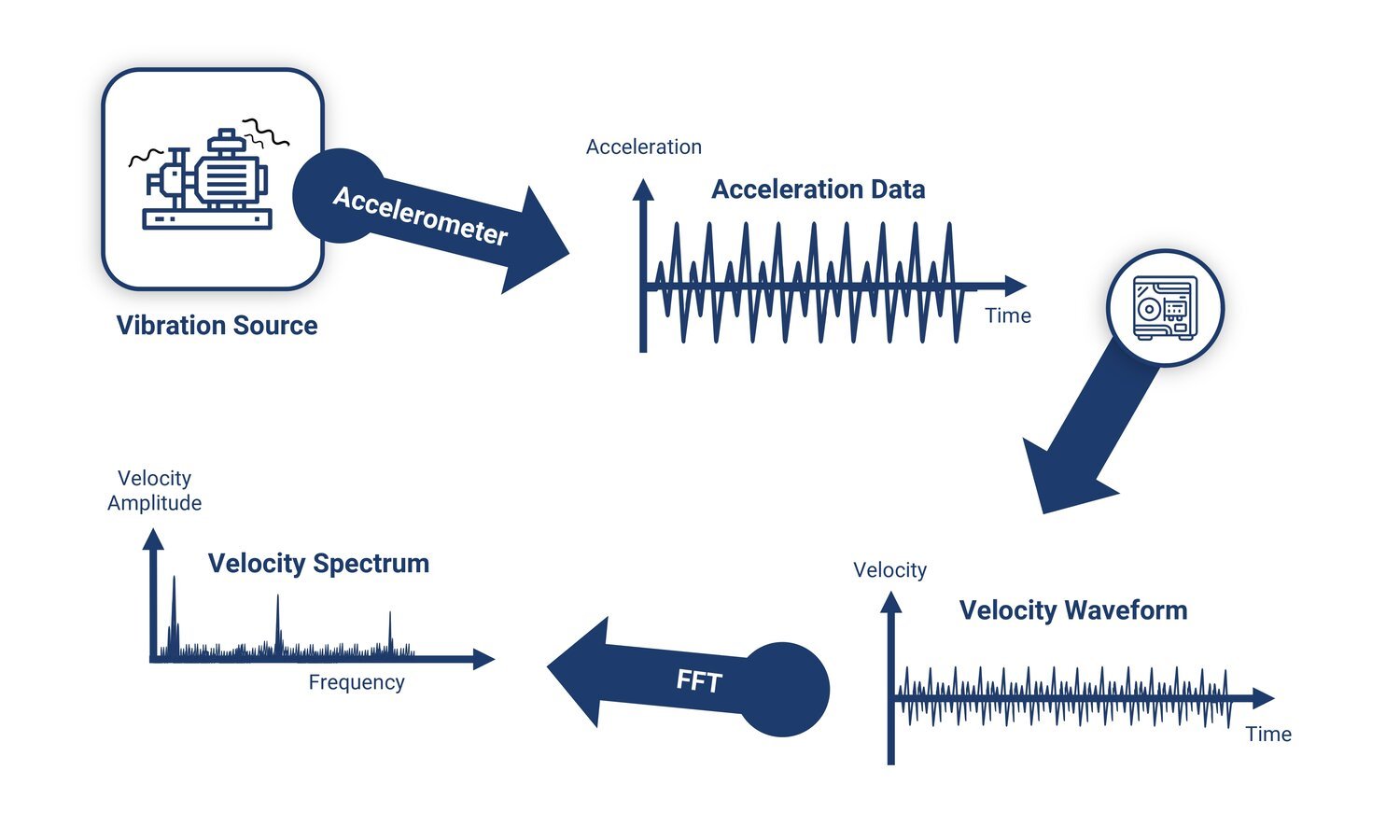


1. Data Collection
Sensors are installed on critical components like bearings and shafts to capture vibration signals such as frequency, amplitude, velocity, and acceleration.
2. Signal Processing
Collected data is processed using methods like:
- Fast Fourier Transform (FFT)
- Time waveform analysis
3. Interpretation
The processed data is analyzed to identify abnormal patterns and diagnose faults.
Key Parameters in Monitoring
Understanding vibration data requires analyzing key parameters:
- Displacement: Measures movement of components
- Velocity: Indicates overall machine condition
- Acceleration: Detects high-frequency issues
- Frequency: Helps identify specific fault types
These parameters provide a deeper understanding of machine health.
Types of Analysis Techniques
Time Domain
Focuses on vibration over time and detects sudden changes.
Frequency Domain
Breaks signals into frequency components to identify specific faults.
Modal Analysis
Used to study structural behavior in advanced applications.
Common Faults Detected


This technique helps detect:
- Imbalance
- Misalignment
- Bearing damage
- Mechanical looseness
- Gear defects
Each issue produces a unique vibration pattern, making diagnosis accurate.
Tools & Technologies
Modern maintenance systems use advanced technologies:
- Wireless sensors for real-time monitoring
- IoT platforms for remote tracking
- AI-based analytics for predictive insights
- Portable devices for manual inspections
👉 Internal Link: Wireless Vibration Analyzer for Predictive Maintenance
These solutions enable continuous monitoring without manual intervention.
Industry Standards
To ensure reliability, industries follow global standards:
- ISO 10816 / 20816 – vibration severity
- ISO 13373 – monitoring guidelines
- ISO 18436 – certification standards
These frameworks ensure consistent diagnostics.
Applications Across Industries
This technique is widely used in:
- Manufacturing (motors, conveyors)
- Power plants (turbines, generators)
- Oil & Gas (pumps, compressors)
- Marine & heavy engineering
- Cement and steel plants
It improves reliability and operational efficiency across sectors.
Future Trends
The future of machine monitoring includes:
- AI-driven predictive systems
- Cloud-based platforms
- Remote diagnostics
- Real-time alerts
With Industry 4.0, systems are becoming smarter and more automated.
Conclusion
Vibration analysis plays a crucial role in predictive maintenance by helping industries detect faults early, reduce downtime, and improve equipment reliability.
By adopting modern solutions such as wireless monitoring systems, companies can move toward fully automated maintenance strategies and achieve higher efficiency.
FAQ Section
What is vibration analysis used for?
It is used to monitor machine condition and detect faults early.
How does it help in predictive maintenance?
It identifies early warning signs, allowing preventive action.
Which machines require monitoring?
Motors, pumps, compressors, and turbines.
What parameters are measured?
Displacement, velocity, acceleration, and frequency.
Is it suitable for all industries?
Yes, it is widely used across multiple sectors.