
If you have searched for the cGMP full form in pharma, here is the direct answer: cGMP stands for Current Good Manufacturing Practice (often written as Current Good Manufacturing Practices). It is a set of regulations that governs how pharmaceutical products must be manufactured to be safe, effective, and consistently high quality—and the small letter “c” carries more weight than most people realize.
This guide explains what cGMP means, why the “current” matters, who enforces it worldwide and in India, the core requirements a manufacturer must meet, and what happens when they are not met.
| cGMP full form in pharma — the quick answer
cGMP = Current Good Manufacturing Practice(s). It is a system of regulations that ensures pharmaceutical products are consistently produced and controlled to quality standards appropriate to their intended use. The “c” (current) means manufacturers must keep using up-to-date systems, technology, and methods — yesterday’s best practice is not enough. |
cGMP Full Form in Pharma: Complete Guide
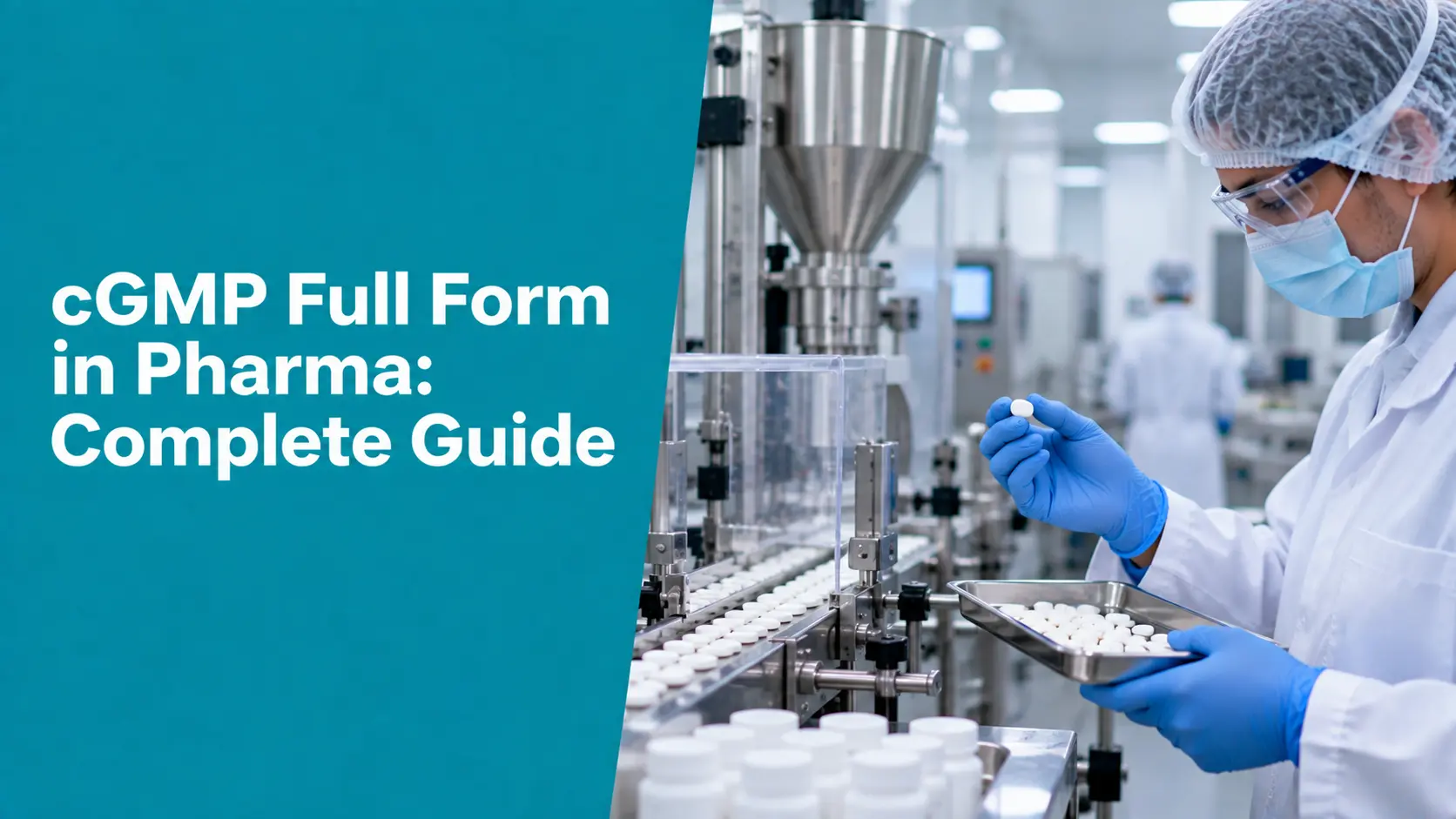
What Does cGMP Stand For?
The full form of cGMP is Current Good Manufacturing Practice. Good Manufacturing Practice (GMP) is a globally recognized framework of quality principles for making medicines; the “c” for “current” is added—most prominently by the U.S. FDA—to stress that compliance is not a one-time checkbox. Manufacturers are expected to continually adopt modern equipment, technologies, and quality systems as they become available. A process that met expectations a decade ago can fall short of cGMP today precisely because the standard moves forward.
cGMP vs GMP: What the “c” Adds
In everyday use, GMP and cGMP are often used interchangeably, and both aim at the same outcome: quality built into the product, not merely inspected at the end. The distinction is emphasis. GMP defines the baseline principles; cGMP underlines that those principles must be applied using current best practices. When the FDA writes “cGMP,” it is signaling that staying static is itself a form of non-compliance. For manufacturers, the practical takeaway is the same either way: quality systems must evolve.
Why cGMP Matters in Pharma
A patient cannot inspect a tablet and know whether it contains the right dose, is free of contamination, or will dissolve correctly. Unlike many products, a defective medicine can be impossible to detect until it causes harm — and finished-product testing alone samples only a fraction of a batch. cGMP closes that gap by controlling the entire manufacturing system, so quality is assured by design rather than caught by luck. That is why regulators treat cGMP not as paperwork, but as the front line of patient safety.
Who Regulates cGMP?
| Authority / Standard | Scope |
| U.S. FDA — 21 CFR Parts 210 & 211 | cGMP regulations for finished pharmaceuticals in the United States. |
| WHO GMP | Global baseline guidelines adopted by many national regulators. |
| EU GMP (EudraLex Vol. 4) | GMP requirements across the European Union. |
| India — Schedule M (CDSCO) | GMP requirements under the Drugs and Cosmetics Act, enforced by CDSCO and state regulators. |
| ICH Q7 / Q10 | GMP for active ingredients (Q7) and the pharmaceutical quality system (Q10). |
cGMP in India: The Revised Schedule M
In India, Schedule M of the Drugs and Cosmetics Act enforces cGMP. It was comprehensively revised — notified in December 2023 — to align Indian standards with WHO-GMP, expanding requirements around the pharmaceutical quality system, validation, documentation, and data integrity. Large manufacturers were required to comply in 2024, while micro, small, and medium units (turnover of ₹250 crore or less) were given until 31 December 2025.
That deadline was not extended further. From January 2026, the revised Schedule M applies across the board, and CDSCO has directed state regulators to carry out risk-based inspections, with strict action for non-compliant units. For Indian pharma manufacturers, cGMP is no longer a future project — it is a current inspection reality.
Core Requirements of cGMP
While the wording differs across regulators, cGMP frameworks share the same pillars. A compliant manufacturer must demonstrate:
- Quality management: a formal pharmaceutical quality system with defined responsibilities and management oversight.
- People and facilities: trained, qualified staff and clean, suitable premises and equipment for the products made.
- Validated processes: processes, cleaning methods, and computerized systems proven to work reliably and repeatably.
- Calibrated instruments: every measuring instrument that affects product quality is calibrated and traceable to national standards.
- Documentation and data integrity: complete, contemporaneous, and tamper-evident records that satisfy ALCOA+ data-integrity principles.
- Control and improvement: testing of materials and product, plus corrective and preventive action (CAPA), complaint handling, and recall procedures.
The Calibration, Validation & Data-Integrity Core
Three of those pillars are where cGMP compliance is most often won or lost — and they are deeply connected. Calibration assures that every measurement behind a quality decision is accurate and traceable. Validation proves that processes, equipment, and computerized systems consistently do what they are supposed to. Data integrity ensures that data are attributable, contemporaneous, accurate, and enduring. A manufacturer can have excellent intentions and still fail an inspection because an instrument was overdue, a process was never formally validated, or a record could not be trusted. Regulators know this, which is why these three areas dominate cGMP and Schedule M findings.
How Zeptac Helps
Zeptac is a SaaS platform for the Testing, Inspection, Calibration, Certification, and Validation industry, built around exactly the pillars cGMP and the revised Schedule M scrutinize most:
- Calibration management: CalTac keeps every instrument calibrated, in date, and traceable to ISO/IEC 17025 and NABL—directly addressing the calibration requirement inspectors check first.
- Validation management: ValTac manages validation of processes, equipment, and computerized systems with the documented evidence cGMP demands.
- Compliance and data integrity: records across the platform meet 21 CFR Part 11 and ALCOA+ standards, so your data integrity stands up to inspection.
- Audit readiness: real-time monitoring and AI-assisted reporting turn compliance from a periodic scramble into a continuous, audit-ready state.
For Indian pharma manufacturers facing Schedule M inspections, that difference is between reacting to findings and walking in already compliant.
What Happens If cGMP Is Not Met?
Non-compliance carries real consequences. In the United States, findings are documented on an FDA Form 483 and can escalate to warning letters, import alerts, and product recalls. In India, units found non-compliant with the revised Schedule M face strict action from CDSCO and state regulators, up to suspension or cancellation of the manufacturing license. Beyond regulators, the reputational damage and lost market access from a cGMP failure often outweigh the cost of compliance many times over.
Conclusion
The cGMP full form in pharma is Current Good Manufacturing Practice — but the acronym is the easy part. The substance is a living quality system that keeps pace with current best practice, enforced by the FDA, WHO, EU, and, in India, the newly strengthened Schedule M now under active inspection. At its core, every inspector examines three things: calibration, validation, and data integrity. Master those, back them with the right systems, and cGMP stops being a threat and becomes a competitive advantage.
| Turn cGMP and Schedule M compliance into a strength
Looking to digitize your calibration, validation, and compliance processes for cGMP and the revised Schedule M? Zeptac’s CalTac and ValTac platforms keep your instruments traceable, your processes validated, and your records audit-ready. Contact our team today to schedule a free demo. |
Frequently Asked Questions for cGMP full form in pharma
Q1. What is the full form of cGMP in pharma?
Answer: The cGMP full form in pharma is Current Good Manufacturing Practice (or Practices). It is a system of regulations ensuring pharmaceutical products are consistently manufactured and controlled to appropriate quality standards.
Q2. What does the “c” in cGMP stand for?
Answer: The “c” stands for “current.” It emphasizes that manufacturers must use up-to-date technologies, systems, and methods — a process that was compliant years ago may no longer meet current expectations.
Q3. What is the difference between GMP and cGMP?
Answer: GMP defines the baseline good-manufacturing principles; cGMP stresses that those principles must be applied using current best practice. They are often used interchangeably, but “cGMP,” especially in FDA contexts, signals that quality systems must continually evolve.
Q4. Who regulates cGMP?
Answer: Globally, the WHO publishes GMP guidelines; the U.S. FDA enforces cGMP under 21 CFR Parts 210 and 211; the EU applies EudraLex Volume 4; and in India, CDSCO and state regulators enforce cGMP through Schedule M of the Drugs and Cosmetics Act.
Q5. What is cGMP under Indian law?
Answer: In India, Schedule M sets out cGMP requirements. The revised Schedule M, notified in December 2023 to align with WHO-GMP, applies to all manufacturers from January 2026; CDSCO will conduct risk-based inspections and take strict action against non-compliant units.
Q6. What are the core requirements of cGMP?
Answer: A pharmaceutical quality system, qualified personnel, suitable premises and equipment, validated processes, calibrated instruments, complete records with data integrity, quality-control testing, and procedures for CAPA, complaints, and recalls.
Q7. What happens if a company fails cGMP?
Answer: Consequences range from an FDA Form 483 and warning letters to import alerts and international recalls, and in India to strict action up to suspension or cancellation of the manufacturing license under Schedule M—plus significant reputational and commercial damage.