
In pharmaceutical manufacturing, a single inaccurate reading can compromise an entire batch — and patient safety along with it. That is why calibration, verification, and validation in pharma sit at the heart of every credible quality system. The three terms are often used interchangeably, but they answer three very different questions: Is my instrument accurate? Is my equipment doing what it should? Is my process reliably producing a safe, effective product?
Getting these definitions wrong is not a semantic problem. It leads to failed audits, regulatory observations, recalls, and lost trust. This guide breaks down each process clearly, explains how they connect, and shows how modern laboratories are digitizing all three to stay continuously audit-ready.
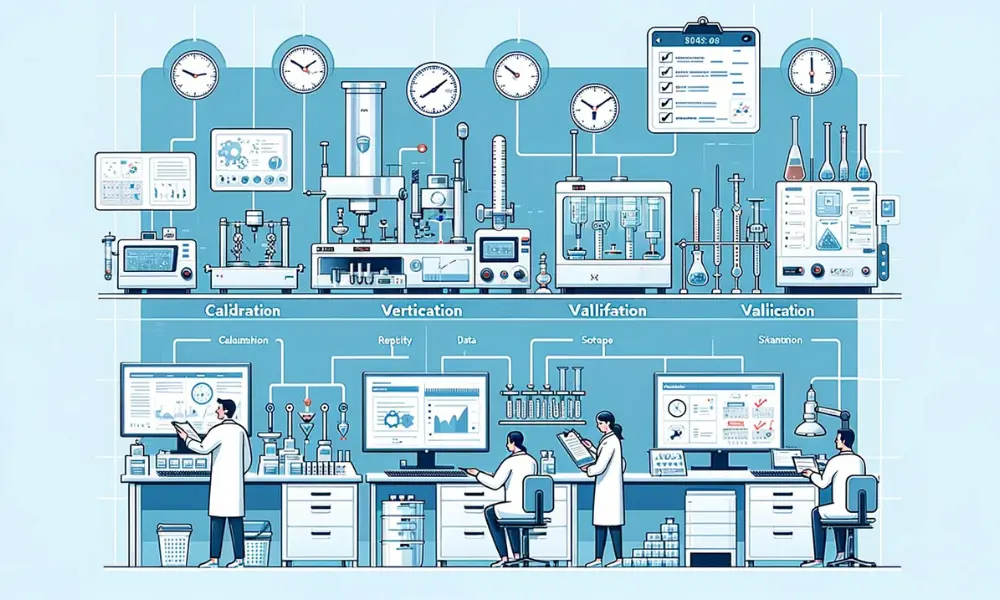
The Problem: Three Words, Constant Confusion
Walk into ten pharma labs, and you will likely hear “calibration,” “verification,” “qualification,” and “validation” used loosely — sometimes for the same activity. This ambiguity creates real risk:
- Wrong control, wrong asset — quality teams apply the wrong process to the wrong equipment.
- Documentation gaps — auditors find inconsistencies because activities were misclassified.
- Treating calibration as a one-off instead of a recurring, traceable obligation.
- Assuming validation is a “do-it-once” event rather than a lifecycle.
The result is a quality system that looks compliant on paper but cannot withstand scrutiny during a regulatory inspection.
Industry Challenges in Maintaining Measurement Integrity
- Stricter data integrity expectations. Regulators expect ALCOA+ principles — Attributable, Legible, Contemporaneous, Original, Accurate — across every record.
- Paper-based bottlenecks. Manual logs, handwritten checks, and spreadsheet protocols are error-prone and slow to retrieve during audits.
- Instrument sprawl. Modern labs run dozens of instruments with different intervals, traceability needs, and acceptance criteria.
- Skilled-resource shortages. Validation engineers and metrologists are expensive and stretched thin.
- Continuous oversight. Compliance must be demonstrable at any moment, not just periodically.
Calibration, Verification, and Validation in Pharma: Definitions and Differences
The cleanest way to separate these three is by what they act on and what they prove.
What Is Calibration?
Calibration is the documented comparison of a measuring instrument against a reference standard with known accuracy, traceable to national or international standards (SI units). It quantifies any deviation, allows adjustment where possible, and reports the associated measurement uncertainty.
- Applies to: measuring instruments and equipment (balances, thermometers, pressure gauges, pipettes, viscometers).
- Answers: How accurate is this instrument, and within what uncertainty?
- Frequency: recurring, at intervals set by risk, usage, and manufacturer guidance.
- Performed by: qualified metrologists or accredited calibration laboratories.
What Is Verification?
Verification is the documented confirmation that an instrument, process, or method continues to meet predefined acceptance criteria. It does not necessarily involve adjustment — it confirms conformity against an existing specification.
- Applies to: instruments between calibrations, established methods, and routine equipment checks.
- Answers: Does this still perform within its specified limits?
- Frequency: routine — often daily, weekly, or before critical use.
- Performed by: trained, authorized personnel following an approved procedure (not “anyone”).
What Is Validation?
Validation is the act of generating documented evidence that a process, method, cleaning procedure, or computer system consistently delivers results meeting predetermined specifications and quality attributes.
- Applies to: processes, analytical methods, cleaning, and computerized systems.
- Answers: Does this reliably and reproducibly do what it is intended to do?
- Frequency: a lifecycle activity, not a one-time event.
Key industry distinction: In pharma, instruments and equipment are calibrated and qualified, while processes, methods, and computer systems are validated. Equipment qualification follows the DQ–IQ–OQ–PQ model (Design, Installation, Operational, and Performance Qualification). This consensus — reinforced by USP general chapter <1058> on Analytical Instrument Qualification — resolves most of the confusion in one sentence.
How the Three Connect
Think of them as a layered hierarchy of assurance:
- Calibration ensures the instrument measures accurately.
- Verification confirms it continues to measure within limits between calibrations.
- Qualification proves the equipment is installed and operating as intended.
- Validation demonstrates that the entire process or system reliably produces high-quality output.
Calibration is therefore a building block within qualification and validation — not a competing concept. You cannot validate a process built on uncalibrated instruments.
Benefits and Business Impact
- Product quality and patient safety — accurate measurements protect every batch.
- Audit confidence — complete, traceable records eliminate scramble-mode before inspections.
- Reduced cost of failure — fewer deviations, investigations, recalls, and rejected batches.
- Operational efficiency — automated scheduling prevents missed calibration due dates.
- Faster turnaround — digital workflows shorten report and certificate generation from days to minutes.
Compliance and Regulatory Considerations
- FDA Process Validation guidance (2011) introduced the three-stage lifecycle — Stage 1: Process Design, Stage 2: Process Qualification, and Stage 3: Continued Process Verification — replacing the old “three validation batches” mindset. Process validation is mandated under 21 CFR 211.100(a).
- EU GMP Annex 15 covers qualification and validation expectations across Europe.
- USP <1058> defines a risk-based approach to analytical instrument qualification.
- ISO/IEC 17025:2017 governs the competence of testing and calibration laboratories, with NABL accreditation in India.
- 21 CFR Part 11 sets requirements for electronic records and signatures, making data integrity central.
- ICH Q7, Q9, and Q10 frame GMP, quality risk management, and the pharmaceutical quality system.
Industry Best Practices
- Define a Validation Master Plan (VMP) that maps each asset to the appropriate control—calibration, qualification, or validation.
- Set calibration intervals by risk, not habit, and justify them with data.
- Maintain metrological traceability to recognized standards, with documented uncertainty budgets.
- Apply a risk-based approach (per ICH Q9) to scale the depth of validation effort.
- Treat validation as a lifecycle with continued process verification, not a one-and-done activity.
- Enforce data integrity (ALCOA+) through audit trails, access control, and electronic signatures.
The Role of Digital Transformation, AI, and IoT
Paper and spreadsheets cannot deliver the continuous oversight regulators now expect. Three technology shifts are reshaping how labs manage calibration, verification, and validation:
- IoT and connected instruments stream live measurement and environmental data into the quality system, enabling real-time monitoring and instant excursion alerts.
- AI-assisted report generation auto-populates certificates and validation reports, performs uncertainty calculations, and flags out-of-specification results.
- Computer system validation (CSV/CSA) and frameworks such as GAMP 5 ensure that software platforms are fit for regulated use.
Together, these turn static documents into living, traceable data — exactly what a lifecycle approach demands.
How Zeptac Helps
Zeptac is a purpose-built SaaS platform for the Testing, Inspection, Calibration, Certification, and Validation industry, designed to manage all three disciplines in one connected environment:
- CalTac automates calibration management — instrument records, due-date scheduling, certificate generation, and automated Type A and Type B measurement uncertainty calculations.
- ValTac streamlines validation workflows for cleanroom, thermal mapping, compressed air, and cold-room validation.
- TestTac runs testing-laboratory operations with ISO 17025 clause-by-clause audit management and NABL quality documentation.
- IoT integration and real-time monitoring capture data directly from dataloggers and instruments.
- AI-powered reporting and compliance management keep labs continuously audit-ready.
By unifying calibration, verification, and validation in pharma on a single platform, Zeptac eliminates documentation gaps that lead to audit findings.
Real-World Use Cases
- A calibration laboratory eliminates missed due dates and instantly generates ISO 17025-aligned certificates, with uncertainty auto-calculated.
- A pharmaceutical QC lab maintains audit-ready instrument qualification and calibration histories, passing inspections without last-minute document hunts.
- A validation service provider delivers thermal mapping and cleanroom validation reports in a fraction of the time required for manual processes.
- A manufacturing quality team uses real-time monitoring to catch environmental excursions before they affect the product.
Future Trends
Expect continued movement toward continuous, data-driven compliance: predictive calibration scheduling using instrument-drift analytics, AI-driven anomaly detection, paperless validation under CSA principles, and tighter IoT integration that makes “audit-ready, always” the operating norm rather than the exception.
Conclusion
Calibration, verification, and validation in pharma are distinct but interlocking pillars of quality assurance. Calibration ensures accuracy, verification confirms ongoing conformity, and validation proves that processes and systems reliably deliver safe, effective products. Treating them as a connected lifecycle — supported by traceable data, IoT, and AI — is now the baseline for any laboratory that wants to stay compliant and competitive. The organizations that digitize these processes turn compliance from a recurring scramble into a continuous, defensible advantage.
Frequently Asked Questions for Differences between Calibration, Verification, and Validation
Q1. What is the difference between calibration, verification, and validation in pharma?
Answer: Calibration compares an instrument to a known reference standard to confirm accuracy. Verification confirms that an instrument, method, or process continues to meet predefined acceptance criteria. Validation generates documented evidence that a process or system consistently produces results meeting specifications. In short: instruments are calibrated, equipment is qualified, and processes, methods, and systems are validated.
Q2. Is calibration part of validation?
Answer: Yes. Calibration is a foundational building block within qualification and validation. You cannot validate a process or qualify equipment that relies on uncalibrated measuring instruments, so calibration underpins the entire quality chain.
Q3.How often should pharmaceutical instruments be calibrated?
Answer: Calibration frequency should be set by risk, instrument type, criticality, usage, and manufacturer recommendations — not by habit. High-risk and heavily used instruments are calibrated more frequently, and intervals should be justified and reviewed with data.
Q4. Is validation a one-time activity?
Answer: No. Since the FDA’s 2011 Process Validation guidance, validation has been a lifecycle that covers process design, process qualification, and continued process verification. Stage 3 monitoring continues throughout the product’s commercial life.
Q5. What do IQ, OQ, and PQ mean?
Answer: The phases of equipment qualification are Installation Qualification (IQ), which confirms correct installation; Operational Qualification (OQ), which confirms the equipment operates to specification; and Performance Qualification (PQ), which confirms it consistently performs for its intended use. Design Qualification (DQ) precedes them.
Q6. Which standards govern calibration and validation in pharma?
Answer: Key references include the FDA Process Validation guidance (2011), EU GMP Annex 15, USP <1058> for analytical instrument qualification, ISO/IEC 17025:2017 for calibration and testing labs (NABL-accredited in India), 21 CFR Part 11 for electronic records, and ICH Q7, Q9, and Q10.
Q7. How can software help manage calibration, verification, and validation?
Answer: Software automates scheduling, traceability, uncertainty calculations, and report generation, while enforcing data integrity (ALCOA+) through audit trails and electronic signatures. This keeps records inspection-ready and removes documentation gaps that lead to audit findings.
Looking to digitize your testing, calibration, validation, or inspection processes?
Zeptac’s advanced SaaS platform helps laboratories and industrial organizations automate workflows, ensure compliance with ISO 17025, NABL, and GMP, and improve operational efficiency.