
ICH Q10 is the blueprint modern pharma uses to run quality. Where GMP tells you what to do at the manufacturing site, ICH Q10 describes the quality system that surrounds it—from development to discontinuation—and keeps the product consistent, controllable, and continually improving throughout its life. It is the model regulators in the US, EU, Japan, and beyond expect a serious pharmaceutical quality system to look like.
This guide explains what ICH Q10 is, its three objectives, its four PQS elements and two enablers, how it fits with GMP and the wider ICH quality family, how to implement it — and the measurement reality that decides whether a Q10 system actually works or looks good on paper.
| What is ICH Q10?
ICH Q10 is an international guideline that defines a model for an effective Pharmaceutical Quality System (PQS) across the entire product lifecycle. It builds on ISO quality concepts, GMP, and ICH Q8 and Q9, and complements rather than replaces regional GMP requirements. Its three objectives are to achieve product realisation, establish and maintain a state of control, and facilitate continual improvement. |
ICH Q10 Pharmaceutical Quality System: Key Points
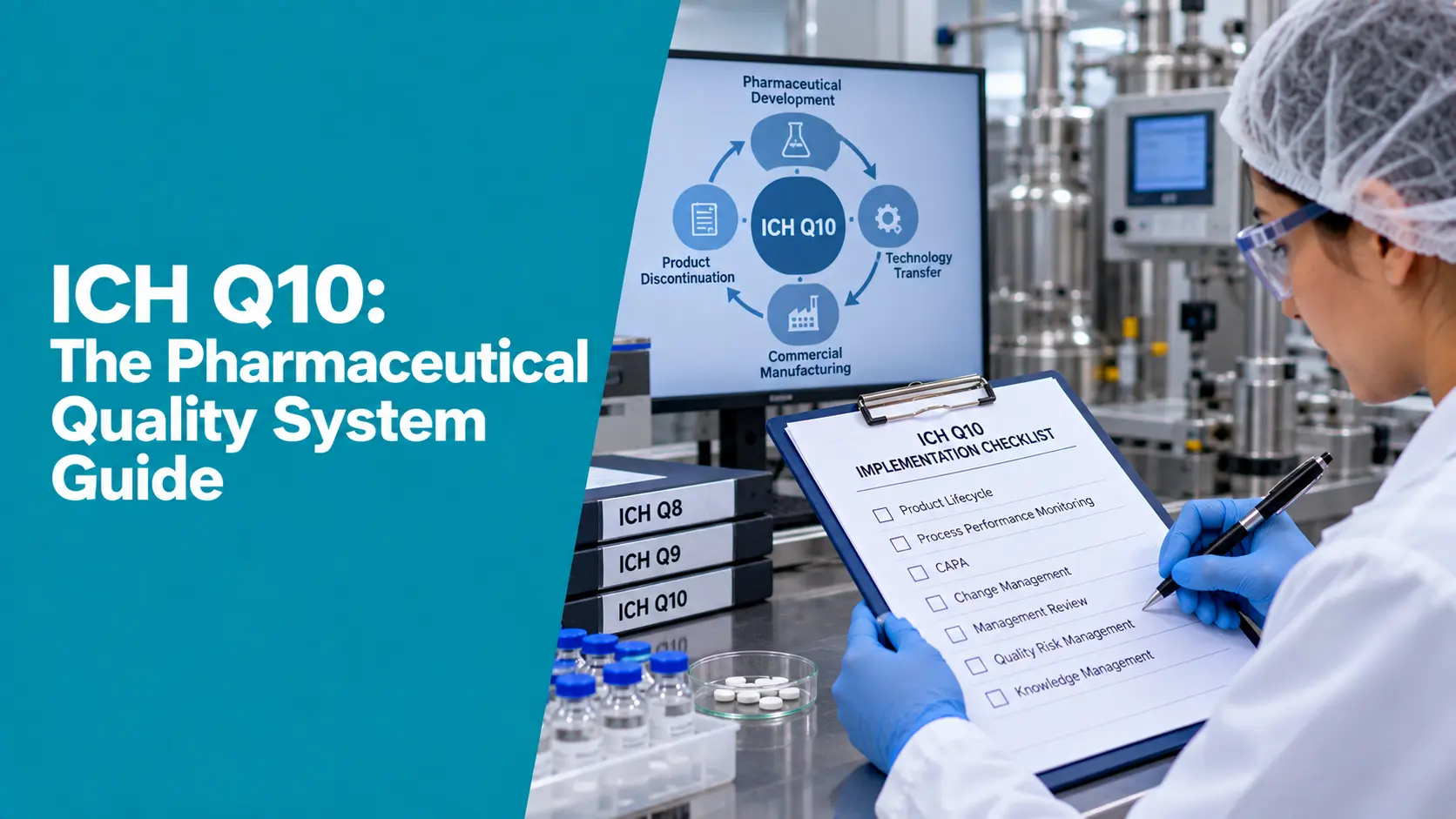
What Is the ICH Q10 Pharmaceutical Quality System?
ICH Q10 is a guideline from the International Council for Harmonisation that sets out a model for an effective pharmaceutical quality system based on ISO quality concepts, GMP, and the principles of ICH Q8 (Pharmaceutical Development) and Q9 (Quality Risk Management). It is not, by itself, legally binding — but as an ICH Step 5 guideline it is adopted by regulatory members and built into regional legislation, and it complements existing GMP such as EU GMP, FDA 21 CFR Parts 210 and 211, and ICH Q7. Its value is a single, harmonised framework accepted across major markets, applied consistently from development through to product discontinuation.
The Three Objectives of ICH Q10
- Achieve product realisation: establish, implement, and maintain a system that consistently delivers products meeting their quality attributes and regulatory requirements.
- Maintain a state of control: operate effective monitoring and control so that process performance and product quality stay assured over time. This is the objective everything else serves.
- Facilitate continual improvement: identify and implement improvements to products, processes, and the quality system itself, reducing variability over the lifecycle.
The Four PQS Elements
ICH Q10 defines four elements that, applied proportionately at each lifecycle stage, keep the system in control and improving:
| PQS Element | What it does |
| 1. Process performance & product quality monitoring | Monitors data and quality metrics to sustain a state of control, detect trends, and find improvements. |
| 2. Corrective & preventive action (CAPA) | Investigates nonconformities, complaints, and findings; fixes root causes; prevents recurrence. |
| 3. Change management system | Assesses, approves, and evaluates changes using quality risk management. |
| 4. Management review | Leadership reviews process, product, and PQS performance and directs improvement. |
The Two Enablers
Two enablers run through every element and objective of ICH Q10:
- Quality Risk Management (QRM): applying ICH Q9 to identify, assess, and control risks to product quality, so effort and controls are focused where risk is highest — including risk-based calibration and validation.
- Knowledge Management: the systematic acquisition, analysis, and retention of knowledge about products and processes, so decisions are data-informed across the lifecycle.
The Product Lifecycle Scope
Unlike GMP, which focuses on commercial manufacturing, ICH Q10 spans the full lifecycle:
- Pharmaceutical development: designing the product and process to consistently meet their intended performance (the domain of ICH Q8).
- Technology transfer: transferring product and process knowledge to manufacturing or between sites without losing integrity.
- Commercial manufacturing: achieving product realisation and maintaining a state of control, while identifying improvements.
- Product discontinuation: managing safe withdrawal, including record and sample retention and continued oversight.
ICH Q10 in the ICH Quality Family
ICH Q10 does not stand alone. It sits within a connected set of quality guidelines: ICH Q8 designs quality into the product and process; ICH Q9 provides the risk-management discipline; ICH Q10 is the overarching quality system that operationalises both across the lifecycle; and ICH Q7 (GMP for active ingredients) plus regional GMP form the regulatory foundation it builds on. The newer ICH Q12 extends the model into structured lifecycle and post-approval change management. Together they turn quality from a series of checks into a coherent, risk-based system.
State of Control Is a Measurement Problem
Here is the reality that decides whether a Q10 system works. ICH Q10 defines a state of control as a condition in which the set of controls consistently assures continued process performance and product quality. Read that again: it is a claim about what you can continuously measure. You cannot assert a state of control over parameters you are not reliably measuring, and Element 1 — the process performance and product quality monitoring system — is where that claim is made or broken. That monitoring is only as trustworthy as the instruments behind it: an out-of-calibration sensor, an unvalidated system, or a broken audit trail means you are monitoring noise and calling it control. A PQS with an elegant CAPA workflow but drifting instruments is not in a state of control — it only looks like it. The measurement, validation, and data-integrity layer is the foundation ICH Q10 quietly rests on.
How to Implement ICH Q10
- Gap assessment: assess your current quality system against ICH Q10 across all lifecycle stages to find the gaps.
- Leadership and governance: secure management commitment, a documented quality policy, and clearly assigned roles.
- Establish PQS elements: build the four PQS elements, enhancing existing procedures rather than starting from scratch.
- Integrate and review: embed lifecycle-based controls, quality risk management, and knowledge management, and run structured management reviews.
How Zeptac Helps
Zeptac is a SaaS platform for the Testing, Inspection, Calibration, Certification, and Validation industry, and it strengthens ICH Q10 exactly where a general quality system is weakest — the measurement and monitoring foundation:
- Trustworthy monitoring: real-time monitoring and IoT feed Element 1 (process performance and product quality monitoring) with live, reliable data, so a state of control is measured, not assumed.
- Calibrated instruments: CalTac keeps every instrument behind that data calibrated and traceable, so the monitoring itself can be trusted.
- Validated systems: ValTac validates processes, equipment, and computerised systems across the lifecycle and technology transfer, with documented evidence.
- Feeding CAPA and knowledge: out-of-tolerance and out-of-specification events feed the CAPA element, while 21 CFR Part 11 and Annex 11 audit trails and ALCOA+ records support knowledge management.
The result is an ICH Q10 pharmaceutical quality system whose state of control is backed by data you can actually defend.
Conclusion
ICH Q10 gives pharma a complete model for quality across the product lifecycle: three objectives, four PQS elements, two enablers, and management ownership, all complementing GMP rather than replacing it. But the model lives or dies on one thing — whether its central promise of a state of control is genuinely measured. Build the elements, embed risk and knowledge management, and, crucially, ground the whole system in calibrated instruments, validated processes, and trustworthy data. Do that, and ICH Q10 stops being a framework you describe in an audit and becomes the way your quality system actually runs.
| Give your ICH Q10 system a foundation of trustworthy data
Looking to digitize the monitoring, calibration, and validation that ICH Q10’s state of control depends on? Zeptac’s real-time monitoring, CalTac, and ValTac platforms keep your pharmaceutical quality system measured and audit-ready. Contact our team today to schedule a free demo. |
Frequently Asked Questions for ICH Q10
Q1. What is ICH Q10?
Answer: ICH Q10 is an international guideline that defines a model for an effective Pharmaceutical Quality System (PQS) across the entire product lifecycle. Built on ISO concepts, GMP, and ICH Q8 and Q9, it complements regional GMP requirements and is adopted into regulation across major markets.
Q2.What are the four elements of the ICH Q10 PQS?
Answer: The process performance and product quality monitoring system, the corrective and preventive action (CAPA) system, the change management system, and management review of process performance and product quality. Applied proportionately at each lifecycle stage, they keep the system in control and improving.
Q3.What is the difference between ICH Q10 and GMP?
Answer: GMP focuses on requirements at the manufacturing site. ICH Q10 describes the entire quality system across the product lifecycle, from development to discontinuation, and complements GMP rather than replacing it. Much of what applies to a manufacturing site is already covered by GMP.
Q4.What are the enablers of ICH Q10?
Answer: Two enablers: Quality Risk Management (applying ICH Q9 to focus controls where risk is highest) and Knowledge Management (systematically acquiring and retaining product and process knowledge for data-informed decisions). Both run through every element and objective.
Q5.How do ICH Q8, Q9, and Q10 relate?
Answer: ICH Q8 designs quality into the product and process, ICH Q9 provides quality risk management, and ICH Q10 is the overarching pharmaceutical quality system that operationalises both across the lifecycle, built on the foundation of ICH Q7 and regional GMP.
Q6.Is ICH Q10 mandatory?
Answer: ICH Q10 is a guideline, not a standalone law, but as an ICH Step 5 guideline, it is adopted by regulatory members and incorporated into regional legislation. In practice, regulators expect a pharmaceutical quality system consistent with its model.
Q7.What is a state of control in ICH Q10?
Answer: A state of control is a condition in which the set of controls consistently assures continued process performance and product quality. Because it is a claim about what is continuously measured, it depends on reliable monitoring, calibrated instruments, and validated systems.