
Ask any plant manager how their line performed last shift, and the answer usually comes from a paper log, a spreadsheet, or an operator’s memory. Ask an automated monitoring system the same question, and the answer comes from the machine itself, captured the instant it happened. The gap between those two answers is often much larger than anyone expects — and it is exactly why manual vs automated data collection has become a real decision, not a philosophical one.
This guide compares the two approaches honestly: where manual data collection still has a place, why automated collection consistently reveals losses manual methods miss, and the one question about accuracy that automation alone can never fully answer.
|
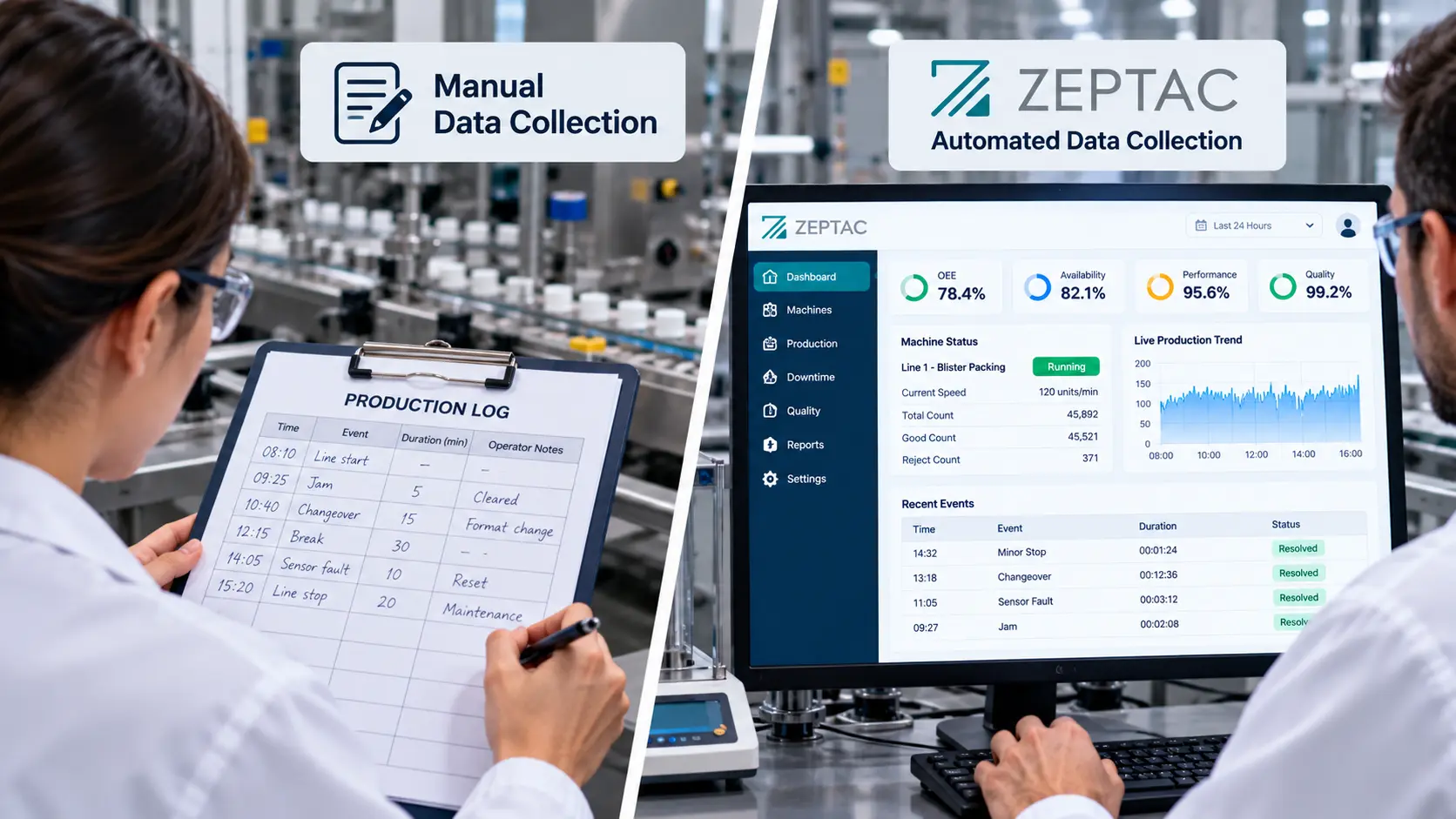
Manual vs automated data collection: the quick answer Manual data collection relies on people recording information by hand or into a spreadsheet, after the fact. Automated data collection uses sensors, PLCs, or machine controllers to capture data continuously and objectively, the moment it happens. Automated collection consistently reveals more downtime and lower utilization than manual logs, because manual methods systematically miss short, frequent events. |
Manual vs Automated Data Collection: Key Differences
What Is Manual Data Collection?
Manual data collection means people — operators, supervisors, or quality staff — recording data by hand on paper forms, in spreadsheets, or through periodic walk-arounds. It requires no capital investment beyond a clipboard or a laptop, and it can capture context and judgment a sensor cannot: why a stop happened, not just that it happened. It also depends entirely on someone remembering to record it correctly every time.
What Is Automated Data Collection?
Automated data collection uses sensors, PLCs, machine controllers, or an IoT gateway to capture data continuously, without a person entering it. Machine state, cycle time, part counts, temperatures, and other variables are logged the instant they occur and flow directly into a database or dashboard. Because nothing is being remembered or transcribed, every event gets captured — including the ones too small or too frequent for a person to reasonably log by hand.
Manual vs Automated: Side by Side
|
Factor |
Manual |
Automated |
|
Effort |
Costs operator time on every entry |
Runs hands-free after setup |
|
Accuracy |
Approximate, subject to memory and bias |
Objective, limited only by sensor accuracy |
|
Timeliness |
Delayed — recorded after the fact |
Real-time, captured the instant it happens |
|
Coverage |
Misses short or frequent events |
Captures every event, however brief |
|
Consistency |
Varies by person and shift |
Same criteria applied every time |
|
Setup cost |
Minimal |
Sensors, integration, and configuration |
The Hidden Gap: What Manual Logging Actually Misses
The starkest way to see the difference is to compare the two on the same shift. Picture a line with frequent short stops — thirty seconds here, a minute there. An operator, working from memory, logs the two or three big breakdowns they clearly remember and reports the line running at roughly 90% availability. An automated system watching the same shift on the same machine logs well over a hundred short stops nobody wrote down, and reports availability closer to 80%. The line did not change between the two measurements — the visibility did. That ten-point gap is not a rounding error; it is real lost capacity that manual logging structurally cannot see, because no person can reasonably log a thirty-second stop every few minutes for eight hours.
This pattern shows up consistently wherever the comparison has been studied: manual data collection tends to flatter performance by missing exactly the small, frequent losses that add up to the largest recoverable capacity on a line.
Why Manual Data Collection Falls Short
- Incompleteness: operators miss events, skip entries when busy, or log only at convenient intervals rather than continuously.
- Inconsistency: different people define a “stop” or a “defect” differently, making shift-to-shift and person-to-person comparisons unreliable.
- Behavioral bias: when people know their activity is being measured, behavior changes — a well-documented effect that skews the very data being collected.
- Delay: by the time data is written down, transcribed, and aggregated, the moment it describes has passed and the chance to react to it in real time is gone.
Where Manual Data Collection Still Has a Place
- Context and reflection: a supervisor writing down why a stop happened captures context and judgment no sensor provides.
- Strategic review: weekly or monthly review conversations benefit from a human summarizing what a number means, not just what it is.
- Simple, stable operations: very low-volume, low-complexity operations may not yet justify the setup cost of automated capture.
The realistic answer for most plants is not “replace manual entirely” but “automate the continuous capture, and let people focus on interpretation and context” — a blend, not a binary choice.
The Question Automation Alone Cannot Answer
Automated data collection is often described as “objective,” and compared to a person’s memory, it is. But objective does not automatically mean accurate. A sensor reports exactly what it measures — correctly or not. A vibration sensor that has drifted, a proximity switch reading intermittently, or a current transducer that has degraded will feed the system data with the same confidence as a properly functioning one. Automation removes human bias from data collection; it does not, by itself, remove instrument bias. That removal only happens if the sensors and instruments behind the automated system are calibrated and traceable. “Automated” answers whether a human recorded the data correctly. It takes calibration to answer whether the sensor did.
How Zeptac Helps
Zeptac’s Real-Time Monitoring and IoT Integration Platform delivers the automated capture that eliminates the manual-logging gap — backed by the instrument-level trust that automation alone does not guarantee:
- Automated data capture: continuous, hands-free capture of machine state, cycle time, and downtime, including every short stop a manual log would miss.
- Calibration management: CalTac keeps the sensors and instruments feeding your automated system calibrated, in-date, and traceable to ISO/IEC 17025 and NABL.
- Real-time visibility: live dashboards surface losses during the shift they happen, not in a weekly report compiled from memory.
- Compliant records: records maintained to 21 CFR Part 11 and ALCOA+ standards for sites where automated data supports quality or compliance decisions.
The result is data that is not just automated, but genuinely trustworthy — the difference between a dashboard you glance at and one you can actually act on.
Conclusion
Manual vs automated data collection is not really a close contest for continuous shop-floor data: automated capture consistently reveals losses — particularly short, frequent stops — that manual logging structurally cannot see, while removing the bias and delay that come with human recording. Manual methods still earn their place in context, reflection, and low-complexity settings. But automation is only as trustworthy as the sensors behind it. Objective is not the same as accurate, and closing that gap takes calibration, not just connectivity.
Automate your data collection, and trust the numbers behind itLooking to move from manual logs to automated, trustworthy shop-floor data? Zeptac’s Real-Time Monitoring and CalTac platforms combine continuous capture with calibrated, traceable instruments. Contact our team today to schedule a free demo. |
Frequently Asked Questions for Manual vs Automated Data Collection
Q1.What is the difference between manual and automated data collection?
Answer: Manual data collection relies on people recording information by hand or into a spreadsheet after the fact. Automated data collection uses sensors, PLCs, or machine controllers to capture data continuously and objectively the moment it happens, without manual entry.
Q2. Why does automated data collection show more downtime than manual logs?
Answer: Manual logging typically captures only the large, memorable breakdowns an operator can recall at shift end, while automated systems record every stop, however brief. Short, frequent stops add up to a significant gap that manual methods structurally cannot see.
Q3. Is manual data collection ever the better choice?
Answer: Yes, for context and reflection, such as documenting why a stop happened, for strategic review conversations, and for very low-volume or low-complexity operations that may not yet justify the setup cost of automation. Most plants benefit from a blend rather than an all-or-nothing choice.
Q4. Does automated data collection remove all bias?
Answer: It removes human recording bias and the Hawthorne effect of people changing behavior when they know they are being watched. It does not remove instrument bias: a drifting or uncalibrated sensor can feed inaccurate data into an automated system with the same confidence as a correctly functioning one.
Q5. How does calibration relate to automated data collection?
Answer: Automated systems are only as accurate as the sensors feeding them. Calibration verifies that those sensors are measuring correctly and are traceable to a reference standard. Without it, “automated” only guarantees consistency of capture, not correctness of the underlying reading.
Q6. What causes the biggest gap between manual and automated measurements?
Answer: Short, frequent stops or micro-stops are the most common source of the gap. Individually too brief or too numerous to log by hand, they are captured completely by an automated system and often represent the single largest source of previously invisible lost capacity.