
What each one does, when you need it, what the standards require, and why your lab needs both.
They get mentioned in the same breath and managed on the same spreadsheet, so it is easy to assume they are the same job. They are not. In the preventive maintenance vs calibration debate, one keeps equipment running, and the other keeps its measurements accurate; confusing the two can leave labs with machines that run perfectly while quietly producing wrong numbers.
This guide settles the preventive maintenance vs calibration question for quality managers, lab owners, and maintenance teams: precise definitions, a side-by-side comparison, when each applies, what ISO 9001, ISO/IEC 17025, and GMP actually require, and how to manage both without drowning in paperwork.
| The short answer
Preventive maintenance is scheduled servicing that keeps equipment functional and prevents breakdowns. Calibration compares an instrument against a traceable reference standard to confirm its measurements are accurate. Calibration is technically a specialized form of preventive maintenance, but it answers a different question: maintenance asks “Does it still work?” while calibration asks “Can I trust what it tells me?” Regulated labs need both. |
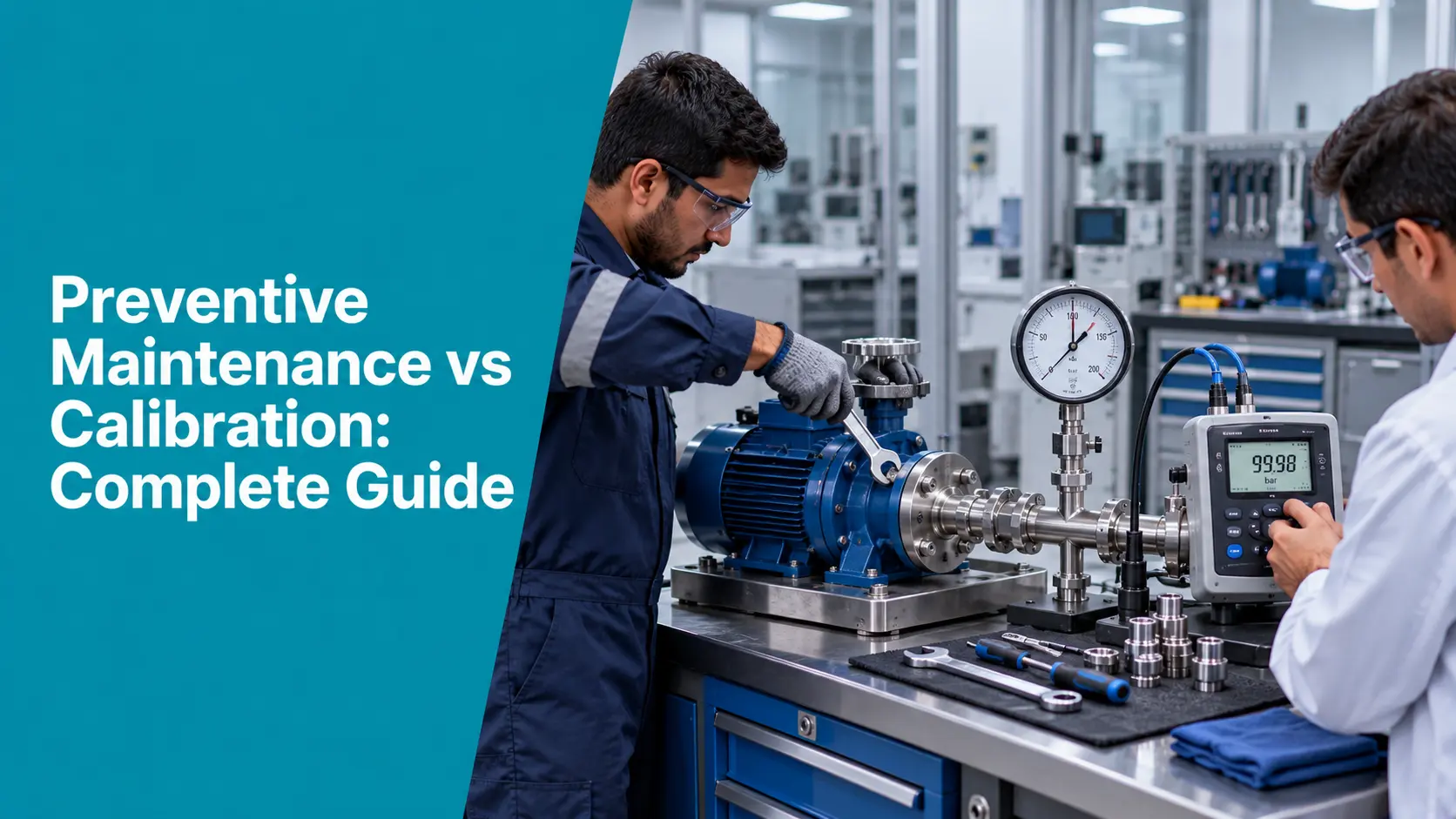
Preventive Maintenance vs Calibration: Complete Guide for Quality Teams
Why the Two Get Confused
Both are planned, recurring, and scheduled against time or usage, so on a calendar they look identical. But they protect different things:
- Preventive maintenance protects uptime and functionality — the equipment keeps running.
- Calibration protects accuracy and traceability — the equipment keeps telling the truth.
A compression tester can be freshly serviced and mechanically perfect yet read several percent off, invalidating results. A centrifuge can be perfectly calibrated for speed yet seize mid-run from a worn bearing. You need both practices because each catches what the other misses.
What Is Preventive Maintenance?
Preventive maintenance (PM) is scheduled equipment servicing that keeps equipment in good working order and helps avoid unexpected failure. It is time- or usage-based rather than triggered by a breakdown — like changing the oil in a car before the engine complains. Typical activities include:
- Cleaning, lubricating, and inspecting moving parts.
- Replacing wear items such as seals, O-rings, filters, and belts.
- Tightening, adjusting, and testing functional performance.
PM sits alongside predictive maintenance (condition-based, using sensor data) and corrective maintenance (fixing after failure). Its goal is reliability and uptime.
What Is Calibration?
Calibration compares an instrument’s output against a reference standard of known accuracy, quantifying any error and its measurement uncertainty. Unlike general maintenance, calibration is about metrological traceability — linking each result through an unbroken chain of comparisons to national or international standards. A calibration tells you whether you can trust a reading and, if adjustment is needed, brings the instrument back within tolerance.
Preventive Maintenance vs Calibration: Key Differences
The clearest way to separate preventive maintenance vs calibration is to line them up side by side:
| Dimension | Preventive Maintenance | Calibration |
| Purpose | Keep equipment functional and reliable | Ensure measurement accuracy and traceability |
| Question it answers | “Does it still work?” | “Can I trust the reading?” |
| Trigger | Time or usage interval | Time, usage, or before critical use |
| Typical output | Service record/maintenance log | Calibration certificate with uncertainty |
| Reference needed | Manufacturer service spec | Traceable reference standard |
| Governing standards | ISO 9001, GMP (211.67) | ISO/IEC 17025, ISO 9001 (7.1.5), GMP (211.68) |
When Do You Need Each?
In the preventive maintenance vs. calibration decision, a simple rule of thumb helps:
- Preventive maintenance: for all critical equipment, test machines, centrifuges, ovens, pumps, HVAC, on a schedule set by manufacturer guidance and usage.
- Calibration: for every instrument that measures a quantity used in a decision — balances, thermometers, pressure gauges, pipettes, gauges — at defined intervals and before high-risk measurements.
Many assets need both. A drying oven needs PM to keep the fan and heaters working, and calibration to prove its temperature is accurate. If either lapses, the results are suspect.
Where They Overlap — and Why You Need Both
This is where the preventive maintenance vs calibration line blurs. Calibration is often described as a specialized form of preventive maintenance, and in practice the two interlock. Good sequencing matters: perform mechanical maintenance first so the instrument is stable, then calibrate to certify accuracy on equipment that is fit for service. Skipping maintenance can cause a calibration to fail; skipping calibration lets a well-maintained machine produce confident but wrong data.
What the Standards Require?
Both sides of the preventive maintenance vs calibration pairing are expected by regulated quality systems, and auditors check for documented evidence of each:
| Framework | What it expects |
| ISO 9001:2015 | Infrastructure maintenance plus measurement traceability — equipment calibrated or verified at defined intervals against traceable standards (Clause 7.1.5). |
| ISO/IEC 17025:2017 | Both maintenance and calibration for equipment fitness, with traceability and uncertainty for measuring devices. |
| GMP / cGMP (21 CFR 211) | Equipment maintenance (211.67) and calibration of automatic/measuring equipment at suitable intervals (211.68); out-of-tolerance equipment removed from service. |
None of these standards set a universal interval; they require a documented, risk-based plan and records to show it was followed.
Best Practices for Managing Preventive Maintenance vs Calibration
To manage preventive maintenance vs calibration well, apply these habits:
- Keep one asset register that tracks maintenance and calibration status for every instrument.
- Schedule by risk, tightening intervals for critical or drift-prone equipment.
- Sequence correctly: maintenance restores fitness, then calibration certifies accuracy.
- Label out-of-tolerance equipment and remove it from service immediately.
- Document everything—service logs, calibration certificates, and next-due dates —so it’s retrievable for audits.
The Role of Software, IoT, and AI
Historically, these lived in separate tools — a CMMS for maintenance, a spreadsheet for calibration. Modern platforms bring them together:
- Unified scheduling with reminders for both maintenance and calibration due dates.
- IoT condition monitoring that flags wear before it causes failure or drift.
- Automated calibration records with uncertainty and instant certificates.
- Predictive intervals set from real usage and drift history rather than a fixed calendar.
How Zeptac Manages Calibration and Maintenance Together?
Zeptac is a SaaS platform for the Testing, Inspection, Calibration, Certification, and Validation industry. Rather than forcing you to choose sides in the preventive maintenance vs calibration split, CalTac (CaliTac) keeps both in one system:
- Single instrument database with maintenance and calibration history for every asset.
- Automated due-date reminders for calibration and service, via SMS and email through InstaCertify.
- Instant ISO 17025-ready certificates with automated Type A and Type B uncertainty.
- IoT and condition-monitoring integration for predictive, data-driven scheduling.
- Audit-ready records aligned to ISO 9001, ISO/IEC 17025, and GMP expectations.
Conclusion
The preventive maintenance vs calibration question is not really either/or. Maintenance keeps your equipment running; calibration keeps its measurements trustworthy—and regulated labs need both, documented and on schedule. Treat them as two complementary halves of one reliability program, manage them in a single system, and you protect uptime, accuracy, and audit readiness at the same time.
Frequently Asked Questions for Preventive Maintenance vs. Calibration.
Q1.What is the difference between preventive maintenance and calibration?
Answer: Preventive maintenance is scheduled servicing that keeps equipment functional and prevents breakdowns, while calibration compares an instrument against a traceable reference standard to confirm its measurements are accurate. Maintenance protects uptime; calibration protects measurement accuracy and traceability.
Q2.Is calibration a type of preventive maintenance?
Answer: Calibration is often described as a specialized form of preventive maintenance because both are planned and recurring. However, their purposes differ: calibration verifies measurement accuracy and traceability, whereas general preventive maintenance keeps equipment mechanically functional.
Q3.Which should be done first, maintenance or calibration?
Answer: Perform mechanical maintenance first so the instrument is stable and fit for service, then calibrate to certify accuracy on equipment that is actually working correctly. Calibrating before needed maintenance can produce a failed or misleading result.
Q4.Do ISO 9001 and GMP require both maintenance and calibration?
Answer: Yes. ISO 9001 requires infrastructure maintenance and measurement traceability (Clause 7.1.5); ISO/IEC 17025 requires both for equipment fitness; and GMP requires equipment maintenance (21 CFR 211.67) and calibration of measuring equipment at suitable intervals (211.68). Auditors expect documented evidence of each.
Q4.How often should preventive maintenance and calibration be performed?
Answer: No standard fixes a universal interval. Both should follow a documented, risk-based schedule informed by manufacturer guidance, usage, criticality, and historical drift, with tighter intervals for high-risk or drift-prone equipment.
Q5.Can one software manage both calibration and maintenance?
Answer: Yes. Modern platforms combine maintenance scheduling and calibration management in a single asset register, with unified reminders, automated certificates, and IoT condition monitoring, replacing the old split between a CMMS and a calibration spreadsheet.
Q6.What happens if you maintain equipment but skip calibration?
Answer: The equipment may run perfectly while producing inaccurate readings. Without calibration, there is no traceable proof that measurements are correct, which can invalidate results, trigger non-conformances, and jeopardize accreditation.