
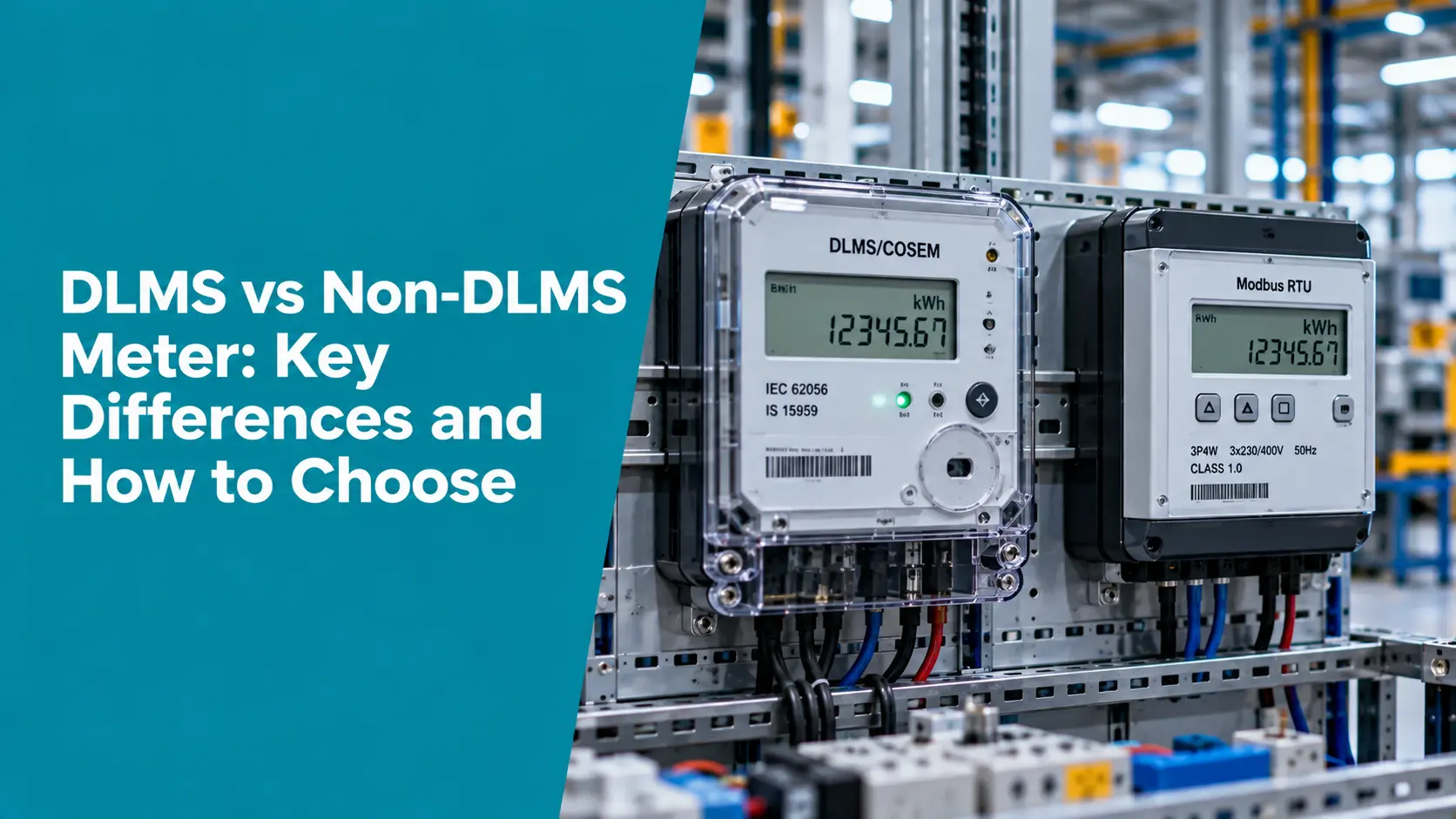
The main difference in the DLMS vs non-DLMS meter question is the language the meter speaks. A DLMS meter exchanges data using the standardised DLMS/COSEM protocol, so software from any vendor can read it the same way. A non-DLMS meter uses Modbus or a manufacturer-specific protocol, so every model needs its own integration work.
That choice decides whether you can mix meter brands, secure the data link, and connect a meter to a utility billing system or a plant dashboard without custom engineering. This guide explains both types, compares them side by side, and shows how to choose. It also covers a point most comparisons skip: speaking the right protocol says nothing about whether the meter measures accurately.
| DLMS vs non-DLMS meter in short
DLMS meter: uses DLMS/COSEM (IEC 62056). Standard data model, vendor-neutral, built-in authentication and encryption. In India, smart meters follow IS 15959, which is based on DLMS/COSEM. Non-DLMS meter: typically Modbus RTU/TCP or a proprietary protocol. Simple and low-cost, but register maps vary by manufacturer and security is limited. Use DLMS for utility billing and smart-metering projects. Use Modbus-type meters for sub-metering inside a plant. Neither protocol tells you whether the meter is accurate. That needs calibration and testing. |
DLMS vs Non-DLMS Meter: What Is the Difference and Which Do You Need?
The Problem: Meters That Cannot Talk to Each Other
Electricity meters have outgrown their dials. They now feed billing systems, demand control, energy dashboards, and compliance reports. That only works if the data can be read reliably, and this is where protocol choice causes trouble.
- Integration cost: each non-standard meter needs its own register map, testing, and documentation.
- Vendor lock-in: a system built around one manufacturer’s protocol is expensive to change.
- Security gaps: unprotected data links on a metering network are a risk to billing integrity and to the wider network.
- Inconsistent data: the same quantity can be labelled, scaled and timestamped differently across meters.
What Is a DLMS Meter?
DLMS stands for Device Language Message Specification. COSEM stands for Companion Specification for Energy Metering. Together they form DLMS/COSEM, defined in the IEC 62056 series and maintained by the DLMS User Association, which also runs conformance certification.
The two halves do different jobs:
- DLMS defines how data is exchanged: the communication services and protocol layers.
- COSEM defines what the data is: an object model that organises registers, load profiles, events and tariffs.
Every quantity in a COSEM meter is an object identified by an OBIS code (defined in IEC 62056-61). So “active energy import” has the same identifier in every compliant meter, whoever made it. The same standard works over different media, including an optical port, RS-485, cellular, RF mesh, or power-line communication.
Security is part of the design. DLMS defines authentication levels, from no security through low-level password authentication to high-level challenge-response methods, and it supports encryption using AES-GCM. Newer security suites add further cryptographic options.
DLMS in India: IS 15959
India’s companion specification is IS 15959, titled Data Exchange for Electricity Meter Reading, Tariff and Load Control, with a Part 2 for smart meters. It is based on DLMS/COSEM. Guidelines issued by the Ministry of Power and the Central Electricity Authority in January 2025 on AMI interoperability require, in Phase A, that all meters support IS 15959, and that a unified head-end system (HES) can read and control meters using it.
What Is a Non-DLMS Meter?
A non-DLMS meter is any meter that does not use DLMS/COSEM. The most common version in industry is a multifunction meter (MFM) with an RS-485 port speaking Modbus RTU, or an Ethernet port speaking Modbus TCP.
Modbus is simple. A master device reads and writes numbered registers on a slave. That simplicity made it ubiquitous in factories, but it has limits:
- Register addresses, scaling, and data types are defined by each manufacturer, so you need the datasheet for every model.
- The classic protocol has no built-in authentication or encryption. A secured variant, Modbus/TCP Security, exists but is not universal.
- There is no standard object model, so events, tamper flags, and billing profiles are vendor-specific or absent.
Some older meters use proprietary protocols or the legacy IEC 62056-21 serial readout. They work, but each is its own integration project.
DLMS vs Non-DLMS Meter: Side-by-Side Comparison
| Factor | DLMS/COSEM meter | Non-DLMS meter (e.g. Modbus) |
| Standard | IEC 62056; IS 15959 in India | Modbus or vendor-defined |
| Data model | Standard objects and OBIS codes | Manufacturer register map |
| Interoperability | High: mix brands on one system | Low: custom mapping per model |
| Security | Authentication and AES-GCM encryption supported | Usually none at protocol level |
| Data depth | Load and billing profiles, event and tamper logs, tariff and load control | Mostly live values and counters |
| Remote control | Standard disconnect/reconnect and parameter commands | Vendor-specific, if available |
| Typical use | Utility smart metering and AMI | Plant sub-metering and energy monitoring |
| Cost and effort | Higher meter cost, lower integration cost at scale | Lower meter cost, higher integration cost per model |
Benefits and Business Impact
- DLMS lowers long-term integration cost. One head-end system can manage many brands, which matters when you scale from tens to thousands of meters.
- DLMS protects revenue data. Authenticated, encrypted communication reduces the risk of tampering with billing readings.
- Modbus gets you monitoring quickly. For a plant that wants machine-level energy data, Modbus meters and a gateway are fast and economical.
- Mixed fleets are normal. Most real facilities run both: a DLMS meter at the utility connection and Modbus meters on feeders and machines.
Compliance and Regulatory Considerations
- IEC 62056 series: the international basis for DLMS/COSEM and OBIS.
- IS 15959: the Indian data-exchange specification expected of smart meters in AMI projects.
- CEA and Ministry of Power AMI guidelines (January 2025): set out interoperability expectations for unified head-end and MDM interfaces.
- Accuracy classes (IEC 62053 series): define how accurate a meter must be, independent of its protocol.
- ISO/IEC 17025: the standard laboratories follow when testing and calibrating meters, with traceability to national standards.
Always confirm the exact specification a utility or tender requires before you buy meters. Requirements differ by project and change with revisions.
The Point Most Comparisons Miss: Protocol Is Not Accuracy
| Communication compliance and measurement accuracy are different tests
DLMS conformance testing checks that a meter communicates correctly. It does not check that the energy it reports is right. Accuracy is verified separately, by comparing the meter against calibrated reference equipment at defined loads and power factors and judging the result against its accuracy class. A meter can read perfectly over DLMS and still drift out of its accuracy class. A Modbus meter can be accurate and awkward to integrate. You need to check both. |
This matters commercially. Energy cost allocation, billing disputes, and carbon reporting all depend on the numbers being right, not just readable. The reference equipment used to test meters must itself be calibrated with traceability, and the tests must be recorded so they stand up to an audit.
How to Choose Between DLMS and Non-DLMS Meters
- Who consumes the data? If a utility, regulator, or billing system, choose DLMS. If your own team, Modbus is usually enough.
- How many meters? The more meters and brands, the more standardisation pays back.
- How sensitive is the data? Billing and revenue data need protocol-level security.
- What will you connect to? Check that your head-end, SCADA, or IoT platform supports the protocol, or that a gateway can convert it.
- How will you prove accuracy? Plan acceptance testing and periodic calibration, whichever protocol you choose.
Role of Digital Transformation, AI, and IoT
Protocols are the plumbing for energy data. Once meters are readable, an IoT platform can collect readings from DLMS and Modbus devices through gateways, store them centrally, and show consumption by line, machine, or shift. Machine learning can then flag abnormal consumption, detect drift between meters that should agree, and support predictive maintenance. The quality of every one of those insights depends on the meters being calibrated.
How Zeptac Helps
- IoT Integration Platform: Brings meter and sensor data into one place, with real-time monitoring and dashboards.
- CalTac: Manages calibration schedules, certificates, and traceability for the reference standards and test equipment used to verify meters.
- TestTac: Runs meter testing workflows, including test records, results, and reports, for laboratories.
- AI-powered report generation: Produces test and calibration reports faster, with consistent formats.
- Compliance and audit readiness: Keeps records organised for NABL and ISO/IEC 17025 assessments.
Real-World Use Case
Consider a manufacturing plant with one utility-installed DLMS meter at its incoming supply and thirty Modbus multifunction meters on feeders and machines. The facility team reads the Modbus meters through a gateway and builds a dashboard of energy per line. The sum of the feeder meters regularly disagrees with the utility meter by a few percent. Rather than blame the protocols, the team calibrates the feeder meters against a traceable reference, finds two have drifted, and corrects them. The dashboard then reconciles with the utility bill, and energy cost allocation becomes defensible.
This is an illustrative scenario reflecting a common pattern, not a specific customer result.
Future Trends
- Interoperable AMI: decoupling communication modules from meters, as envisaged by the Phase B approach in the CEA guidelines.
- Stronger cryptography: wider use of advanced DLMS security suites as cyber-risk concerns grow.
- Secure Modbus and gateways: more protected links for industrial meters.
- Analytics at the edge: gateways pre-processing meter data before it reaches the cloud.
Conclusion
The DLMS vs non-DLMS meter decision comes down to who needs the data, how many meters you manage, and how much protection the data link needs. DLMS gives you standardisation and security for utility-grade metering. Non-DLMS meters give you quick, economical visibility inside the plant. Whichever you choose, the numbers are only trustworthy if the meters are tested and calibrated against traceable standards.
Connect your meters and trust your readingsZeptac’s IoT Integration Platform, CalTac and TestTac help organisations bring meter data into one system and keep the instruments behind it calibrated and audit-ready. Contact our team today to schedule a free demo → |
Frequently Asked Questions for DLMS vs non-DLMS meters
Q1. What is a DLMS meter?
Answer: A DLMS meter is an electricity meter that exchanges data using DLMS/COSEM, the standardised protocol and data model defined in the IEC 62056 series and maintained by the DLMS User Association. Any compliant software can read its data in the same way.
Q2. What is a non-DLMS meter?
Answer: A non-DLMS meter uses a protocol other than DLMS/COSEM, most often Modbus RTU or Modbus TCP, or a manufacturer’s own protocol. The data layout is defined by the manufacturer, so integration needs the meter’s register map.
Q3. What does COSEM mean?
Answer: COSEM stands for Companion Specification for Energy Metering. It defines the object model, meaning how meter data such as energy, demand, and events are organised, while DLMS defines how that data is exchanged.
Q4. Is IS 15959 the same as DLMS?
Answer: No, but they are closely related. IS 15959 is the Indian companion specification for data exchange for meter reading, tariff, and load control, and it is based on DLMS/COSEM. Indian smart-metering guidelines expect meters to support IS 15959.
Q5. Is Modbus a DLMS protocol?
Answer: No. Modbus is a separate, older, and simpler protocol that reads and writes numbered registers. It is widely used for sub-metering in factories but does not carry the standardised object model or built-in security of DLMS/COSEM.
Q6. Can a non-DLMS meter be used for utility billing?
Answer: Generally not for smart-meter rollouts, where DLMS-based interoperability is expected. Non-DLMS multifunction meters are typically used for internal energy monitoring and cost allocation, not for utility tariff billing.
Q7. Does DLMS compliance mean a meter is accurate?
Answer: No. DLMS compliance proves the meter communicates according to the standard. Accuracy is a separate property, proven by testing against the meter’s accuracy class using calibrated reference equipment.