
ISO 8655:2022 procedures, the gravimetric method, tolerances, and best practices for accurate, audit-ready pipetting.
In molecular biology, clinical diagnostics, and pharmaceutical QC, a micropipette is often the smallest instrument in the lab and the one your results depend on most. A few microliters of error can quietly invalidate an assay, a batch release, or a research finding. Knowing how to calibrate a micropipette correctly — against a traceable reference method and at the right volumes — is what keeps liquid handling trustworthy.
This guide shows quality managers, calibration and testing laboratories, validation engineers, and pharmaceutical teams exactly how to calibrate a micropipette to the current ISO 8655:2022 standard: what calibration measures, a step-by-step gravimetric procedure, the applicable tolerances, and the best practices and software that keep every pipette audit-ready.
| In short
Here’s how to calibrate a micropipette: dispense distilled water with the pipette and its tip, weigh each delivery on a precision balance, convert mass to volume using the water’s Z-factor, and compare the result against the ISO 8655 maximum permissible errors for accuracy (systematic error) and precision (random error). Test at least three volumes—100%, 50%, and 10% of nominal—with at least 10 measurements per volume in a controlled environment, and record all results in a traceable certificate. |
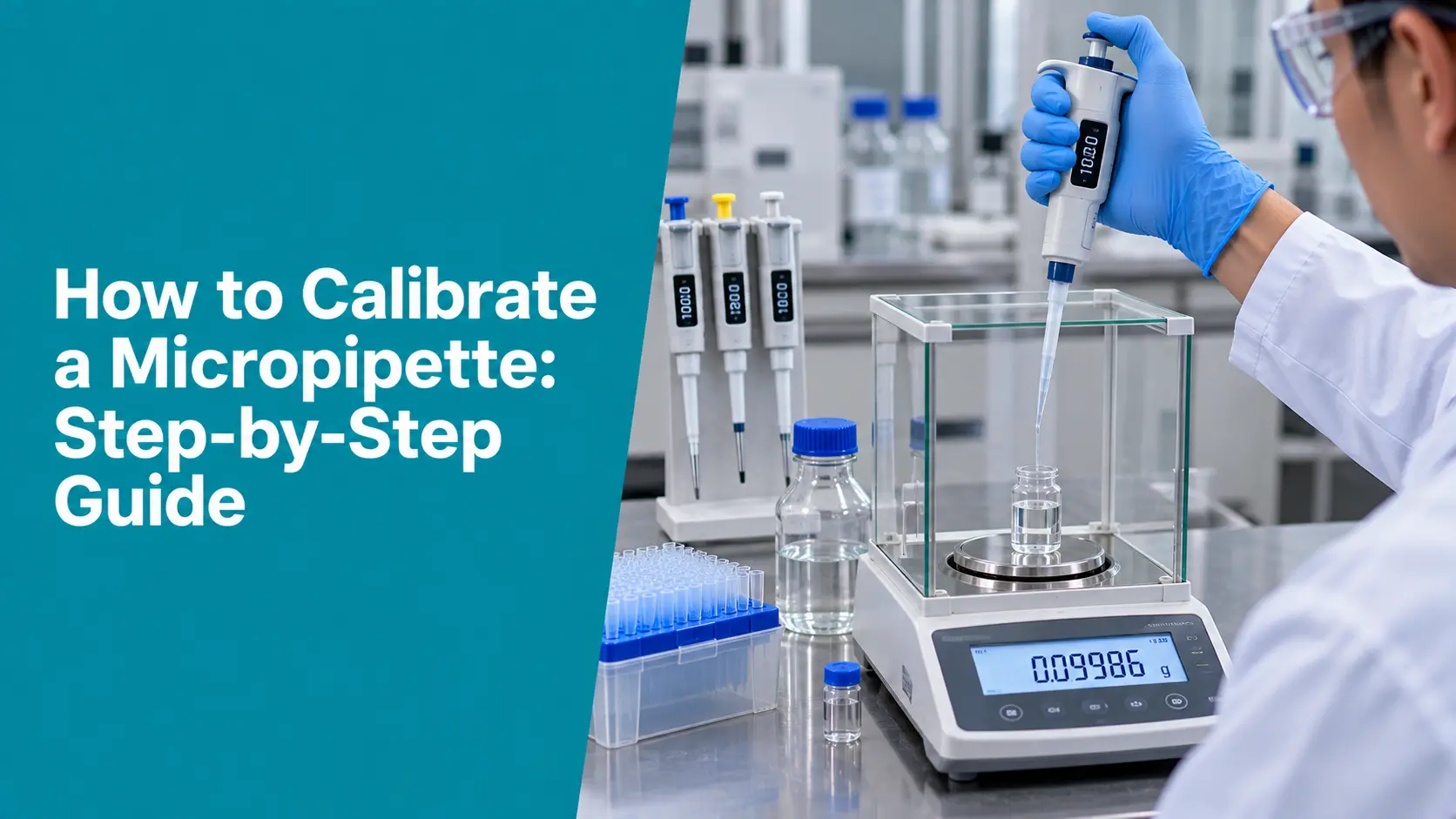
How to Calibrate a Micropipette: Complete Guide
The Problem: Why Pipetting Accuracy Slips Unnoticed
A micropipette rarely announces that it has drifted. It keeps dispensing what appears to be the right volume while the actual delivery quietly drifts out of tolerance. Several forces cause this:
- Worn seals, O-rings, and pistons from heavy daily use change the aspirated volume.
- Temperature and humidity that alter liquid density, evaporation, and the pipette’s own materials.
- Poor technique — inconsistent speed, angle, tip immersion depth, or failure to pre-wet the tip.
- Wrong or ill-fitting tips that break the seal between tip and instrument.
- Aggressive or corrosive reagents that degrade internal components over time.
The cost surfaces late and expensively: failed assays, out-of-specification batches, wasted reagents, disputed results, and audit findings. Routine calibration turns that invisible risk into a measured, documented one.
Key Challenges in Micropipette Calibration
- Small volumes, big uncertainty. At low microlitre volumes, evaporation and balance resolution dominate error and demand tight environmental control.
- Environmental sensitivity. ISO 8655 requires controlled — not merely monitored — temperature, humidity, and a vibration-free, draft-free bench.
- Volume of instruments. A single lab may run hundreds of pipettes, each needing scheduled calibration, history, and certificates.
- Manual data and transcription errors. Weighing, Z-factor conversion, and manual statistics are slow and error-prone.
What Micropipette Calibration Actually Measures
Calibration establishes the relationship between the volume a pipette is set to deliver and the volume it actually delivers, together with the associated uncertainty. The governing standard is ISO 8655, comprehensively revised in 2022, which covers piston-operated volumetric apparatus (pipettes, burettes, dilutors, dispensers, and syringes).
A crucial change in ISO 8655:2022 is that it treats the pipette and its tip as a single system—a pipette is considered calibrated only with the specific tip type used during the test. The standard defines two reference procedures, gravimetric (Part 6) and photometric (Part 8), plus permitted alternative methods (Part 7), and no longer treats the gravimetric method as automatically superior.
Accuracy vs Precision
- Accuracy (trueness / systematic error): how close the mean delivered volume is to the volume you set.
- Precision (repeatability / random error): how consistent repeated deliveries are with one another.
A pipette can be precise but inaccurate (tightly clustered, but off target) or accurate on average but imprecise. ISO 8655 sets maximum permissible errors for both, now specified at 10%, 50%, and 100% of nominal volume rather than at the nominal volume alone.
The Gravimetric Reference Method
In the gravimetric method, the pipette dispenses distilled or deionized water onto a calibrated analytical balance. Convert the measured mass to volume using the Z-factor, which corrects for water density, temperature, air pressure, and buoyancy. Select the balance per ISO 8655-6 so its uncertainty in use stays well within a quarter of the pipette’s permissible systematic error.
How to Calibrate a Micropipette: Step by Step
The steps below show how to calibrate a micropipette using the ISO 8655 gravimetric reference method. Always follow the pipette manufacturer’s documentation in addition to the standard.
- Stabilize the environment. Equilibrate the pipette, tips, and water in the calibration room (typically 15–30°C, stable, >50% relative humidity, draft- and vibration-free) for at least a couple of hours.
- Inspect and prepare. Check the pipette for damage, smooth plunger movement, and a correctly fitted, undamaged tip of the type to be certified. Record the as-found condition before any adjustment.
- Set up the balance. Use a balance with resolution appropriate to the test volume, fitted with an evaporation trap or humidified chamber, and tared with water in place.
- Pre-wet the tip. Aspirate and dispense the test volume a few times so the tip’s internal humidity stabilizes and results are representative.
- Dispense and weigh across three volumes. Test at 100%, 50%, and 10% of nominal volume, taking at least 10 measurements at each using a consistent technique (angle, speed, immersion depth).
- Convert mass to volume. Apply the Z-factor for the recorded water temperature and pressure to convert each weighing to a delivered volume.
- Calculate accuracy and precision. Compute the systematic error (mean vs. set volume) and random error (repeatability) at each volume, and compare against the ISO 8655 limits.
- Adjust, re-test, and certify. If any result is out of tolerance, adjust per the manufacturer, repeat, and issue a traceable calibration certificate with a next-due date.
| Acceptance at a glance
A pipette passes when both its systematic error (accuracy) and random error (precision) fall within the ISO 8655 maximum permissible errors at every tested volume, using the tip type stated on the certificate. Tighter in-house limits are common in regulated pharmaceutical and clinical work. |
Choosing Test Volumes and Frequency
- Test volumes: 100%, 50%, and 10% of nominal (or the pipette’s minimum) to characterize performance across its range, not at a single point.
- Replicates: at least 10 measurements per volume for a statistically meaningful result.
- Interval: typically every 3–6 months; tighten for heavy use, critical applications, or regulated environments; verify new pipettes before first use.
Benefits and Business Impact
Learning how to calibrate a micropipette properly — and doing it on schedule — pays back well beyond the audit file:
- Reliable, reproducible results that stand up to peer review and regulatory scrutiny.
- Lower reagent and rework costs by catching drift before it spoils assays or batches.
- Stronger compliance with ISO 8655, ISO/IEC 17025, GLP, GMP, and NABL expectations.
- Full traceability with documented, retrievable calibration history for every pipette and tip system.
Compliance and Regulatory Considerations
Micropipette calibration sits inside a framework of standards most relevant to TIC laboratories and regulated manufacturers:
| Standard / Framework | Relevance to pipette calibration |
| ISO 8655:2022 | The core standard for piston-operated volumetric apparatus — test methods, permissible errors, and reporting. |
| ISO/IEC 17025 | Competence, traceability, and uncertainty requirements for accredited calibration and testing laboratories. |
| OECD GLP / 21 CFR (GMP) | Equipment qualification and data-integrity expectations for regulated pharma, clinical, and research work. |
| ALCOA+ data integrity | Calibration records must be attributable, legible, contemporaneous, original, and accurate. |
| NABL (India) | Accreditation requirements aligned to ISO/IEC 17025 for calibration and testing laboratories. |
Two principles cut across all of them: every result must be traceable to national or international standards, and every calibration must be documented in enough detail to reconstruct it during an audit.
Industry Best Practices
Once you know how to calibrate a micropipette, these habits keep every result reliable and defensible:
- Control the environment; don’t just watch it. Stabilize temperature and humidity and use an evaporation trap for low volumes.
- Standardize technique. Consistent speed, angle, immersion depth, and tip pre-wetting reduce operator-driven error.
- Calibrate the pipette-and-tip as a system. Certify with the tip brand and type actually used in the lab.
- Verify between full calibrations. Quick interim checks catch drift early.
- Keep complete records. Log environment, volumes, replicates, results, and adjustments for every instrument.
The Role of Digital Transformation, AI, and IoT
Today, calibrating a micropipette is as much a data-management question as a metrology question. Paper worksheets lose data and invite transcription errors; a connected workflow keeps the instrument, the method, and the record together:
- Direct balance capture streams weighings into the calibration record, removing manual entry.
- Automated uncertainty and Z-factor calculation apply Type A and Type B evaluation consistently.
- AI-assisted certificates generate compliant reports instantly and flag out-of-tolerance channels.
- Real-time reminders and dashboards surface pipettes that are due, overdue, or drifting before they cause a problem.
How Zeptac Helps You Calibrate a Micropipette
Zeptac is a SaaS platform built for the Testing, Inspection, Calibration, Certification, and Validation industry. Its calibration solution, CalTac (CaliTac), reshapes how you calibrate a micropipette — turning weighing sheets and manual maths into a controlled digital workflow:
- Generate instant, ISO 17025-ready certificates from your reading tables in a few clicks.
- The platform automatically calculates Type A and Type B uncertainties to ensure accurate, repeatable results.
- Complete instrument database — specifications, reference-standard records, and full calibration history for every pipette.
- Due-date reminders and ready-to-print stickers through InstaCertify, so nothing slips past the due date.
- Built-in ISO 17025 and NABL controls — internal audits, master-document revisions, and audit-ready records.
The result is faster turnaround, fewer transcription errors, and a pipette fleet that is audit-ready at any moment.
Real-World Use Cases
These examples show how to calibrate a micropipette efficiently across very different operations:
- Accredited calibration laboratory: certifies hundreds of customer pipettes to ISO 8655, auto-generating certificates with uncertainty and tracking instrument movement without spreadsheets.
- Pharmaceutical QC lab: ties pipette calibration to GMP data-integrity controls, with tamper-evident records and full traceability for inspection.
- Clinical and research labs: schedule routine checks across multiple benches to protect assay reliability and reproducibility.
Future Trends in Pipette Calibration
How to calibrate a micropipette is evolving from a periodic chore into a continuous, data-driven practice:
- Predictive intervals set from historical drift data rather than a fixed calendar.
- Connected balances and IoT sensors that automatically log the environment and weighings.
- Cloud-native, paperless records accessible to auditors and quality teams anywhere.
- AI anomaly detection that reviews calibration data before issuing a certificate.
Conclusion
Accurate liquid handling underpins the credibility of every result a lab produces. Knowing how to calibrate a micropipette — to ISO 8655, across three volumes, with the tip treated as part of the system, and fully documented — is what keeps that accuracy honest. Pair a disciplined, standards-based procedure with software that automates uncertainty, certificates, scheduling, and calibration, and calibration stops being an audit burden and becomes a quiet competitive advantage.
Frequently Asked Questions for How to Calibrate a Micropipette
Q1. How do you calibrate a micropipette?
Answer: To calibrate a micropipette, equilibrate and inspect it, fit the correct tip, then dispense distilled water onto a precision balance. Convert each weighing to volume using the Z-factor; take at least 10 measurements at 100%, 50%, and 10% of nominal volume; calculate accuracy and precision against the ISO 8655 limits; adjust as needed; and issue a traceable certificate.
Q2. How often should a micropipette be calibrated?
Answer: A common interval is every 3–6 months, with tighter intervals for heavy use, critical applications, or regulated environments, and always in line with your quality system and the manufacturer’s guidance. Verify new pipettes before first use.
Q3. What standard applies to micro pipette calibration?
Answer: ISO 8655:2022 is the governing standard for piston-operated volumetric apparatus, including pipettes. It defines gravimetric (Part 6) and photometric (Part 8) reference procedures, permissible errors at 10%, 50%, and 100% of nominal volume, and reporting requirements. Accredited work is also performed in accordance with ISO/IEC 17025.
Q4. What is the gravimetric method?
Answer: The gravimetric method weighs distilled water dispensed from a pipette on a calibrated balance and converts the mass to volume using the Z-factor, which accounts for water density, temperature, air pressure, and buoyancy. It is the most widely used reference procedure in ISO 8655.
Q5. What is the difference between accuracy and precision in pipetting?
Answer: Accuracy (trueness) is how close the mean delivered volume is to the set volume, reflecting systematic error. Precision (repeatability) is how consistent repeated deliveries are and reflects random error. ISO 8655 sets maximum permissible limits for both.
Q6. Can I calibrate a micropipette myself?
Answer: In-house calibration is possible with trained staff, a suitable balance, a controlled environment, and traceable procedures. For accredited, certificate-backed results, use an ISO/IEC 17025 laboratory or a controlled calibration management system to standardize micropipette calibration.
Q7. Why must the pipette and tip be calibrated together?
Answer: ISO 8655:2022 treats the pipette and its tip as a single system because tip fit and quality directly affect the delivered volume. A pipette is only considered calibrated for the specific tip type used during the test, so the certificate should state that tip type.
| Ready to digitize your calibration workflow?
Looking to digitize your testing, calibration, validation, or inspection processes? Zeptac’s advanced SaaS platform helps laboratories and industrial organizations automate workflows, ensure compliance, and improve operational efficiency — anytime, anywhere. |